In the years after the Second World War, the US Air Force had a problem it could not explain. Planes were going down, and neither the pilots nor the machines seemed to be at fault. The cockpits had been built to fit the average pilot, sized from body measurements taken decades earlier, and one theory was simply that pilots had grown.
So in the early 1950s a young researcher named Gilbert Daniels was asked to measure them again. He measured more than 4,000 pilots on ten body dimensions, and then asked a question nobody had thought to ask: how many of them were actually average? He defined average generously, anywhere in the middle 30 percent of the range for each dimension. The answer was none. Not one pilot was average on all ten.
A cockpit built for the average pilot fit nobody in particular. The lasting fix was to stop designing for the average and make the equipment adjust to the person: seats that move, straps that tighten.
Your physiology has the same problem
Health numbers are usually presented the way those cockpits were built: against a population. A resting heart rate between 60 and 100 is “normal”. An HRV of such-and-such is “good for your age”. Those ranges are not wrong, exactly. They are just answers to a different question.
The trouble is that people differ from each other far more than any one person differs from day to day. HRV is the extreme case: it varies enormously by age, genetics and fitness, and by which statistic a device reports, so one person’s healthy 30 is another person’s bad morning. Resting heart rate is subtler. If your normal is 52 and you wake up at 64, you are well inside the textbook range and also clearly not yourself. The population chart says fine. Your own history says something is going on: a short night, a hard session, a late meal, a cold on its way.
Comparing yourself with everyone else mostly tells you who you are. Comparing yourself with yourself tells you how you are today. The second question is the one that is useful at 7 am.
What Wave reads against
Today’s Wave, the daily score in Wave Wellness, reads every morning against your own previous 30 days, not a population average. HRV is compared with the median of your last 30 days, and a 30 percent swing either way uses all 30 of the points it can move. Resting heart rate counts the other way round, so a 10 percent rise above your usual takes off 20.
Using the median rather than the average is a small choice that matters. One awful night or one feverish morning does not drag your baseline with it, because a median barely notices a single outlier.
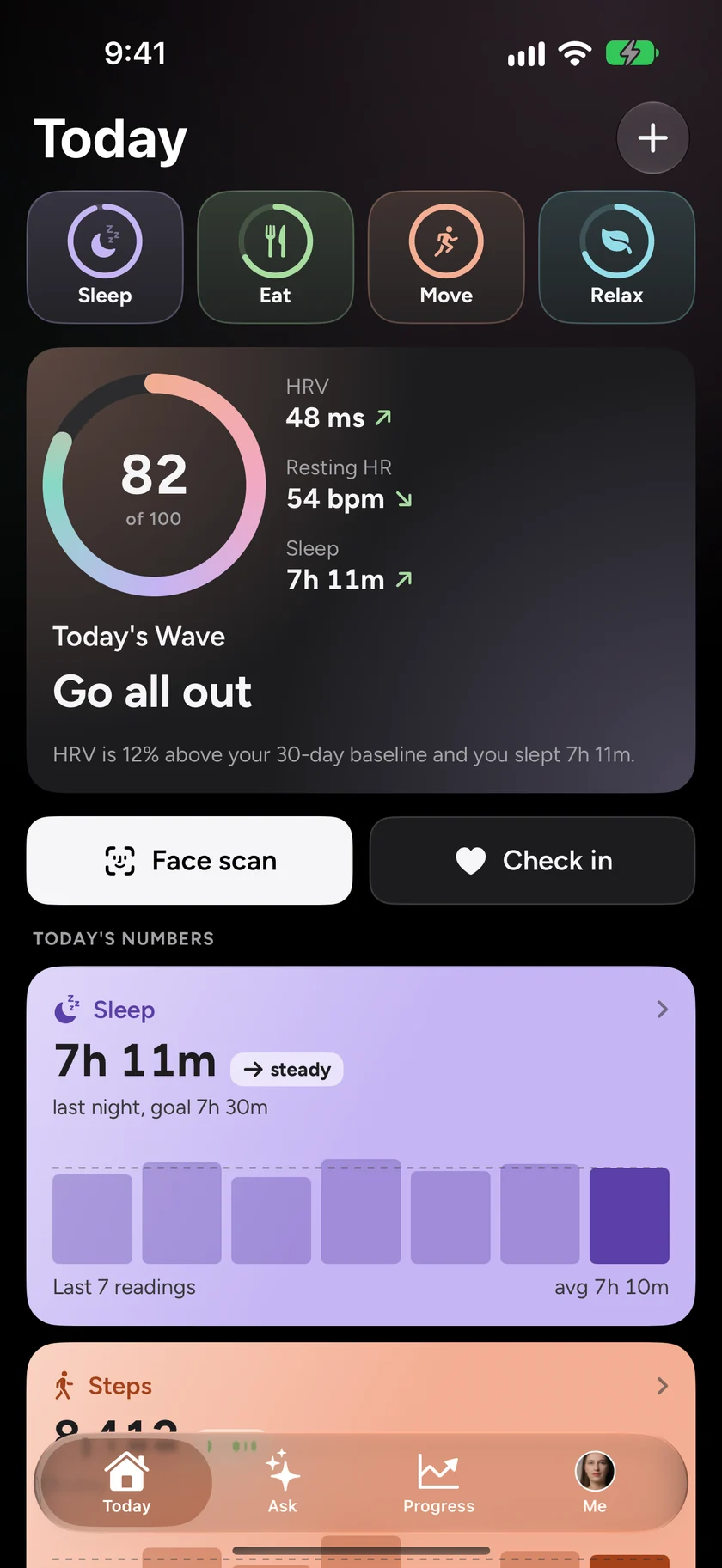
The sentence under the score names the two inputs that moved it most, in your terms: “HRV is 12% above your 30-day baseline and you slept 7h 11m.” Not above average. Above you.
Sleep is the one honest exception. It is scored half against your own usual and half against seven hours, so a long habit of short nights is not graded as fine just because it has become yours.
What a baseline needs
A baseline is not something you have on day one. It is something you build, and it needs two things.
Time. Under seven days of baseline, Today’s Wave shows its score as a range of plus or minus 8, marked thin, and with no morning data at all it says “Not enough yet” rather than guessing. The first week is a sketch. By the end of the first month the comparison means something.
Consistency. A baseline is only as good as the conditions it is built from. Overnight readings from a wearable are the steadiest, because sleep strips away most of the noise. If you use the morning WellnessScan instead, take it at the same point in your morning each day, sitting, before coffee. Thirty mornings measured in thirty different ways is a baseline of noise.
What a baseline cannot see
A rolling baseline follows you, and that is also its blind spot. If something drifts slowly over months, the 30-day window drifts with it, and every morning looks normal against a normal that is itself sliding. That is why it is worth looking at the longer picture now and then, not only today’s call.
And population ranges still have a job: they mark the edges. A resting heart rate that sits very high or very low, or a number that comes with symptoms, is a matter for a doctor whatever your baseline says.
The Air Force stopped building for the average pilot and started building seats that adjust. A baseline is a seat that adjusts.
Wave Wellness is free on the App Store and Google Play. Download it and see your own Today’s Wave today.
Wave is for general wellness and is not a medical device. It does not diagnose anything; talk to a doctor about a heart rate or rhythm that worries you.