A blank space and a wrong number look very different on a screen. One is obviously missing something. The other looks finished: two digits, a decimal point, maybe a little arrow. That is exactly why the wrong number is more dangerous. A blank makes you careful. A confident number makes you act.
Most health apps are designed to never show a blank. Wave Wellness is designed to show one whenever the data has not earned a number yet.
False precision is a kind of lie
There is a name for a figure that looks more certain than the evidence behind it: false precision. “Your HRV is 47.3 ms” sounds like a measurement. If it came from eleven seconds of a shaky recording in a dim kitchen, it is a guess wearing a lab coat.
The harm is not in the guess. Everyone estimates. The harm is in the presentation, because people reasonably treat precise-looking numbers as precise. You see a score drop and you skip the workout. You see a marker move and you worry for a week. A number shown is a number acted on, so every number on the screen is making a promise about how much it knows.
There is a second, quieter problem. Early data is mostly noise. Your first three mornings of resting heart rate tell you about those three mornings: a bad night, a coffee, a rushed start. Treat them as your baseline and every comparison after that is measured against an accident. Small samples swing, and an app that reports the swing as a trend is teaching you to chase noise.
The honest alternative is unglamorous. Say how sure you are. When you are not sure enough, say that instead.
Every place Wave refuses to guess
This shows up all through the app, and each one was a choice somebody had to make against the easier option.
The daily score under seven days. Today’s Wave is read against your own 30-day baseline. Before you have seven days of one, it does not pretend: it shows a range of ±8 and marks it thin. With no morning data at all, it does not invent a score. It says “Not enough yet”.
The WellnessScan’s signal quality. Every scan is stored with how good the signal was. A meter under the live pulse wave tells you while you are scanning whether the read is strong enough, and a poor reading is labeled as one, never quietly averaged into your trend.
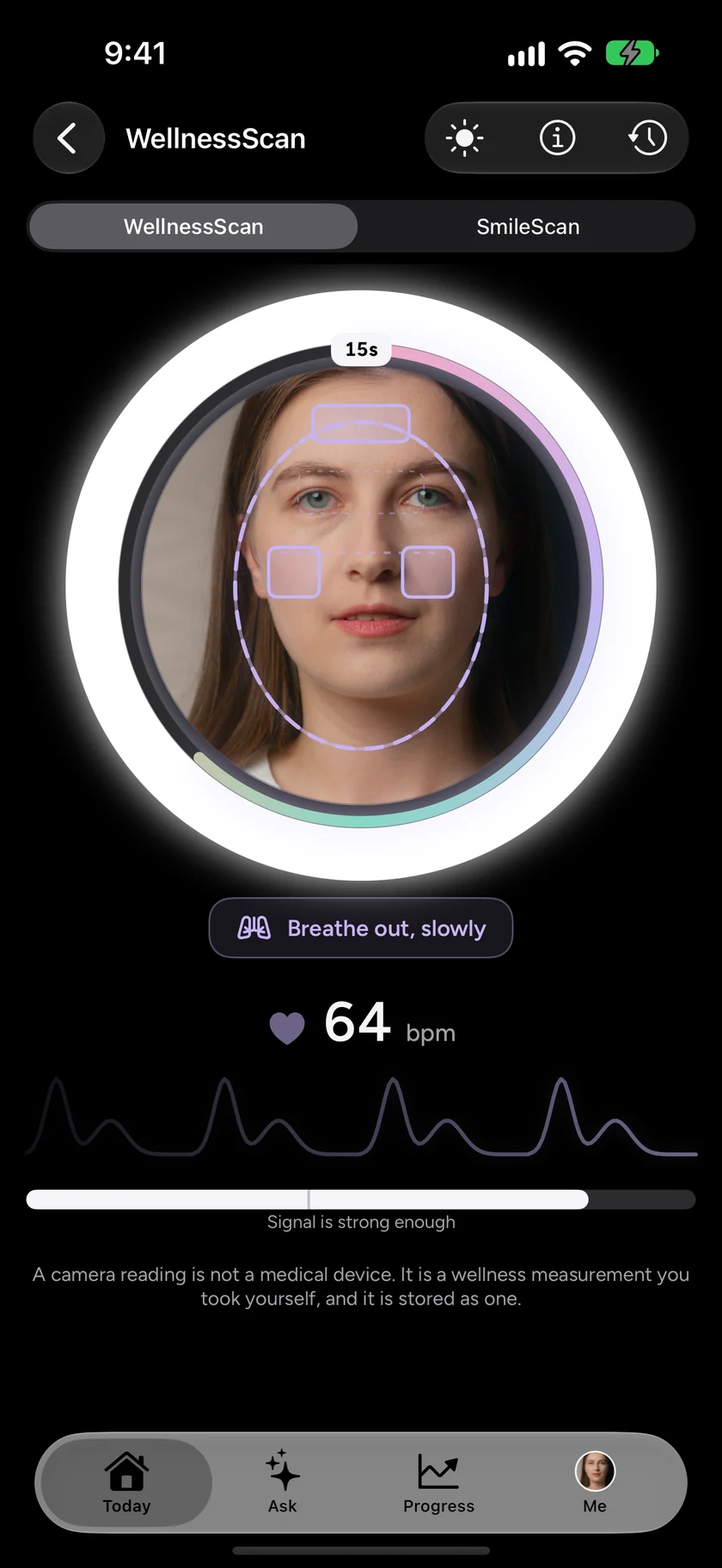
HRV in particular. Heart-rate variability depends on the exact timing between individual beats, which makes it the most fragile thing a camera can read. The scan gates it hardest of everything it reports, and when the recording is too short or too noisy, it withholds the number rather than guessing.
Wave Age: nine markers or no number. The lab half of Wave Age uses PhenoAge (Levine, 2018), which needs nine specific blood markers. If one is missing, the app names the missing one and does not calculate. It would be easy to drop in a population average for the gap and show you an age anyway. That age would be partly yours and partly a stranger’s, with no way for you to tell which part.
The check-in: unanswered is null, not 3. Each of the five questions runs 1 to 5. If you skip one, it is recorded as no answer, not as the middle of the scale. That sounds like bookkeeping. It is not. Fill every skipped answer with a 3 and your averages slide toward “fine” on exactly the days you were too busy or too low to tap, and the record ends up describing a calmer person than you.
The SmileScan: “cannot tell”. Each weekly check compares six areas, from gum line to shade and stain, with your baseline. Every area can come back same, a little different, different, or cannot tell. Photos drift. The light changes, the angle changes. When they have drifted too far to compare fairly, “cannot tell” is the correct answer, and the app gives it.
Why this is harder than it sounds
Refusing to answer costs something. An empty card feels like a broken app. People want a number on day one, and every product instinct says to give them one. Software asked for an answer will usually produce one. A chart with a gap in it looks worse than a chart with a smooth line drawn through the gap.
So the restraint has to be built in at the level of the code, not left to good intentions. Wave’s daily score is plain arithmetic precisely so that missing inputs stay missing: there is nothing in the formula that can make up a value it was not given.
What you get in exchange
Withholding a number has a payoff that only shows up later. When Wave does show you a figure, it means it. A score is a real score. A trend is built from readings that were good enough to keep. Every input to a Wave Age is your own, with nothing borrowed to fill a gap.
It also makes you a better judge of your own data. Once you are used to an app that says “not enough yet”, you start noticing how rarely anything else does.
Confidence is cheap to display and expensive to earn. A tool you are going to make decisions with should only show you the kind it has earned.
Wave Wellness is free on the App Store and Google Play. Download it and see all of it working together today.
Wave is for general wellness and is not a medical device. It does not diagnose or treat anything; talk to a doctor about any result that worries you.