Longevity

How old your body is running is a number you can move.

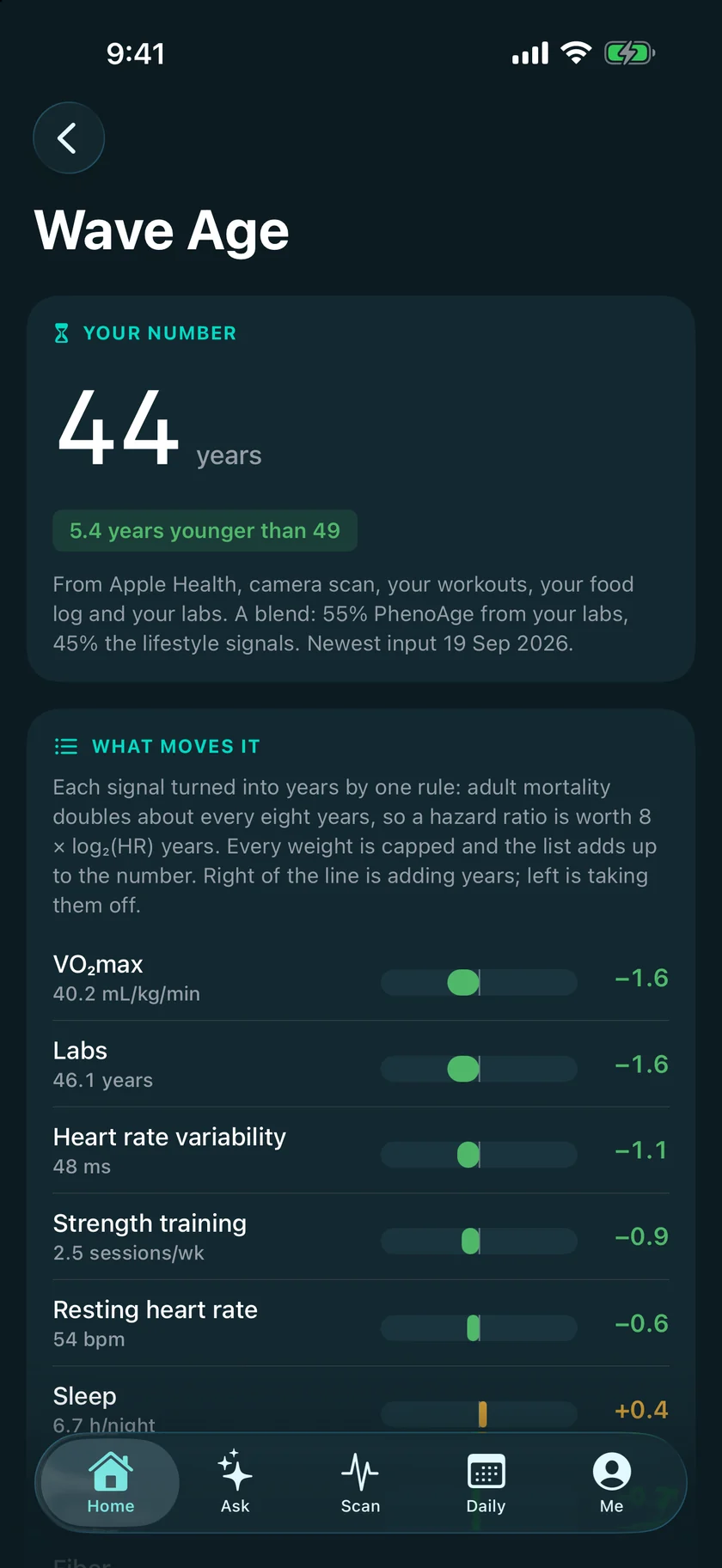
Wave reads your bloodwork, your training, your sleep, what you eat and what you take, and returns one age. Not a mood ring: a published model with its arithmetic on the page, and every year of it traced back to the thing that added it.

The Wave Age screen: 44 years, and every input listed with the years it adds or takes off.
What goes in

Eight inputs, each with its source.

PhenoAge, when you have the labs, and a lifestyle model built from named cohort studies on top of it. The two are blended 55/45 when both exist, and the lifestyle age answers on its own from the scan, the wearable, sleep, food and training until the labs arrive.

Nothing is invented for a signal that is not there. It is simply not in the sum, and the summary says how many signals the number stands on.

  • Nine blood markersPhenoAge (Levine, 2018), fitted on NHANES mortality follow-up, carries 55% of the blend. All nine ride on a routine CMP, CBC and hs-CRP.
  • Resting heart rateAbout 16% more risk per 10 bpm above 60 (Jensen, 2013). From your wearable, or from the morning face scan.
  • Cardiorespiratory fitness13% less risk per MET above the norm for your age and sex (Kodama, 2009), from your estimated VO2max.
  • Daily stepsA dose-response curve against a reference of 7,500 a day (Paluch, 2022).
  • Sleep durationUnder 6 hours or over 9 a night carries more risk (Cappuccio, 2010).
  • Strength trainingOne to two sessions a week, about 15% less risk (Momma, 2022).
  • Protein and fiber25 to 29 g of fiber a day, about 15% less risk (Reynolds, 2019).
  • What you takeSupplements and protocols, judged against the markers they are meant to move.
  • 8inputs, each with its sourcebloodwork, heart, fitness, steps, sleep, strength, food, what you take
  • 9blood markersall on a routine CMP, CBC and hs-CRP
  • 55%of the blend from the labsPhenoAge, fitted on NHANES mortality follow-up
  • 3rules it never bendsno substitution, stated arithmetic, every year attributed
The three rules

A number this loaded has to show its work.

Nothing is substituted for a missing marker

The model wants nine values. With eight it would produce a number that looks identical to a real one and is not, so a panel missing anything returns no lab age at all and names what it is missing, which is exactly what to add to the next draw.

Lifestyle has its own stated arithmetic

Each signal becomes years by one published rule: adult mortality doubles roughly every eight years, so a hazard ratio is worth 8 x log2(HR) years. The ratios come from named cohort studies, every one is capped, and the lifestyle age stands on its own when the labs are short.

Every year is attributed

The app re-runs the model with one input moved to the middle of its healthy range and reports the difference. That is what "sleep is costing you 0.4 years" means: a real counterfactual, not a share of a total invented to make a chart add up.

Try it

Move the sliders. Watch the number.

42.4Wave Age1.4 years older than your birthday
  • Sleep6.5h+0.7 y

    7 to 8 h. Short sleep carries about 12% more risk, long sleep about 30%. Cappuccio 2010

  • Daily steps5500−1.1 y

    7,500 a day. A dose-response that flattens out somewhere past ten thousand. Paluch 2022

  • Strength sessions0/wk0.0 y

    1 to 2 a week. About 15% less risk, and the benefit plateaus rather than compounds. Momma 2022

  • Resting heart rate72bpm+2.1 y

    60 bpm or below. About 16% more risk for every 10 bpm above 60. Jensen 2013

  • Fiber16g−0.2 y

    25 to 29 g a day. About 15% less risk at the range the evidence is strongest for. Reynolds 2019

An illustration, not your Wave Age. It uses the published effect sizes above and one stated assumption, that adult mortality risk roughly doubles every eight years, to turn a hazard ratio into years. The app's own model is weighted differently and leans 55% on nine blood markers. Nothing here is a prediction about any individual, and none of it is medical advice.

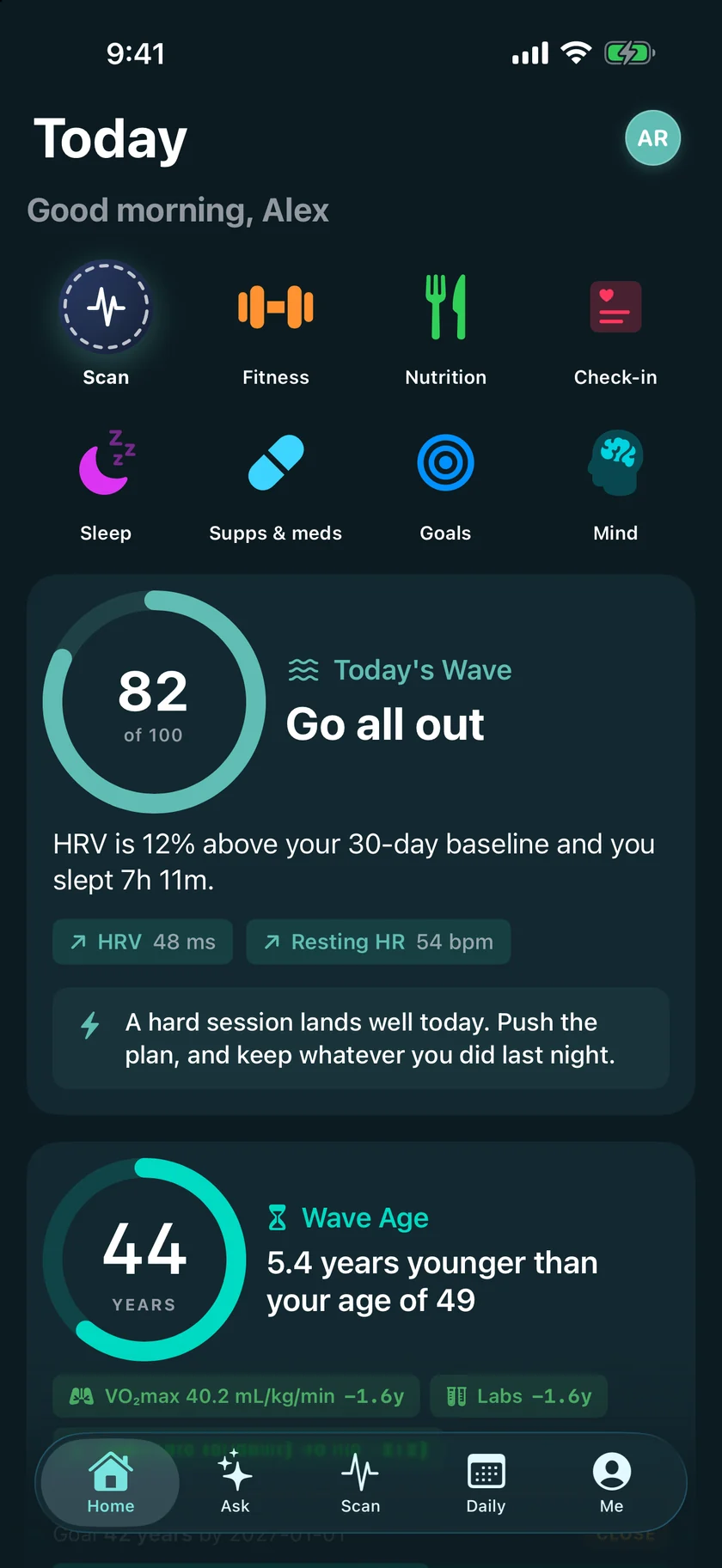
The Today screen with the Wave Age ring and the goal line beneath it.
A goal, not a verdict

Set the age you want and watch the line travel.

The ring on Today is the tent-pole of the app for a reason: it is the one number everything else feeds. Set a target and a date, and the goal line under the ring shows the real figure moving toward it, with the inputs that are pulling it there and the ones holding it back.

  • Your labs, charted over time, each value confirmed by you before it counts.
  • A supplement or protocol judged against the markers it was meant to move.
  • Remove the goal and every reading stays; only the target goes.

Wave Age is a wellness estimate built on published research. It is not a diagnosis, not a prognosis, and not a substitute for your doctor's read of your labs.

The number you can move, waiting for your first morning.

Join the list. Bring a recent blood panel if you have one; the lifestyle age answers either way.

Download on the App StoreLaunching in October
Get it on Google PlayLaunching in October