The most important number in Wave Wellness is produced by code a high-school student could check with a pencil. It starts at 60. It adds and subtracts some points. It stops at 0 and at 100. There is a comment at the top of the file that reads, in capitals, “THERE IS NO MODEL CALL IN HERE”.
That is not an oversight in an app with an AI built into it. It is the most deliberate decision in the product.
A number you act on has a different job
Most of what an app shows you is there to be read. A chart, a summary, a note about your week: you look, you take what is useful, you move on. If the wording changes from one day to the next, nothing is lost.
A daily score is different. You act on it. It is the thing that decides whether today is the hard session or the walk, the early night or the late one. And a number you act on has to meet three tests that a paragraph never does.
It has to be reproducible. The same morning, scored twice, must give the same number. Language models are built to generate, and generation varies: ask one the same question twice and you can get two different answers, each reasonable. That is a feature in a conversation and a defect in a measurement. If your score could move a few points because the model phrased its reasoning differently, every small change in it would be noise you could not tell from signal.
It has to be explainable. When the number drops, you need to know which input dropped it, because that is the lever you can actually pull. A model can produce an explanation, but an explanation written after the fact is a story about the number, not the number’s actual cause. Arithmetic does not need a story. The cause is the sum.
It has to be stable over time. Your score from March has to mean the same thing as your score from October, or the trend is meaningless. Models get updated. A formula only changes when someone changes it on purpose, and when they do, it is written down.
Put those together and you arrive somewhere slightly unfashionable: the number you trust most should come from the most boring code you own.
What is actually in the sum
Today’s Wave reads you against your own 30-day baseline, not a population average, and it is built like this:
- Start at 60.
- HRV, up to ±30. A 30% swing against your prior 30-day median uses all 30 points.
- Resting heart rate, up to ±20, inverted. A 10% rise costs the full 20.
- Sleep, up to ±20. Half measured against your own usual, half against seven hours.
- Yesterday’s strain, −10 to +5, against the week before.
- Your check-in, up to ±15, from the mood and energy you tapped in.
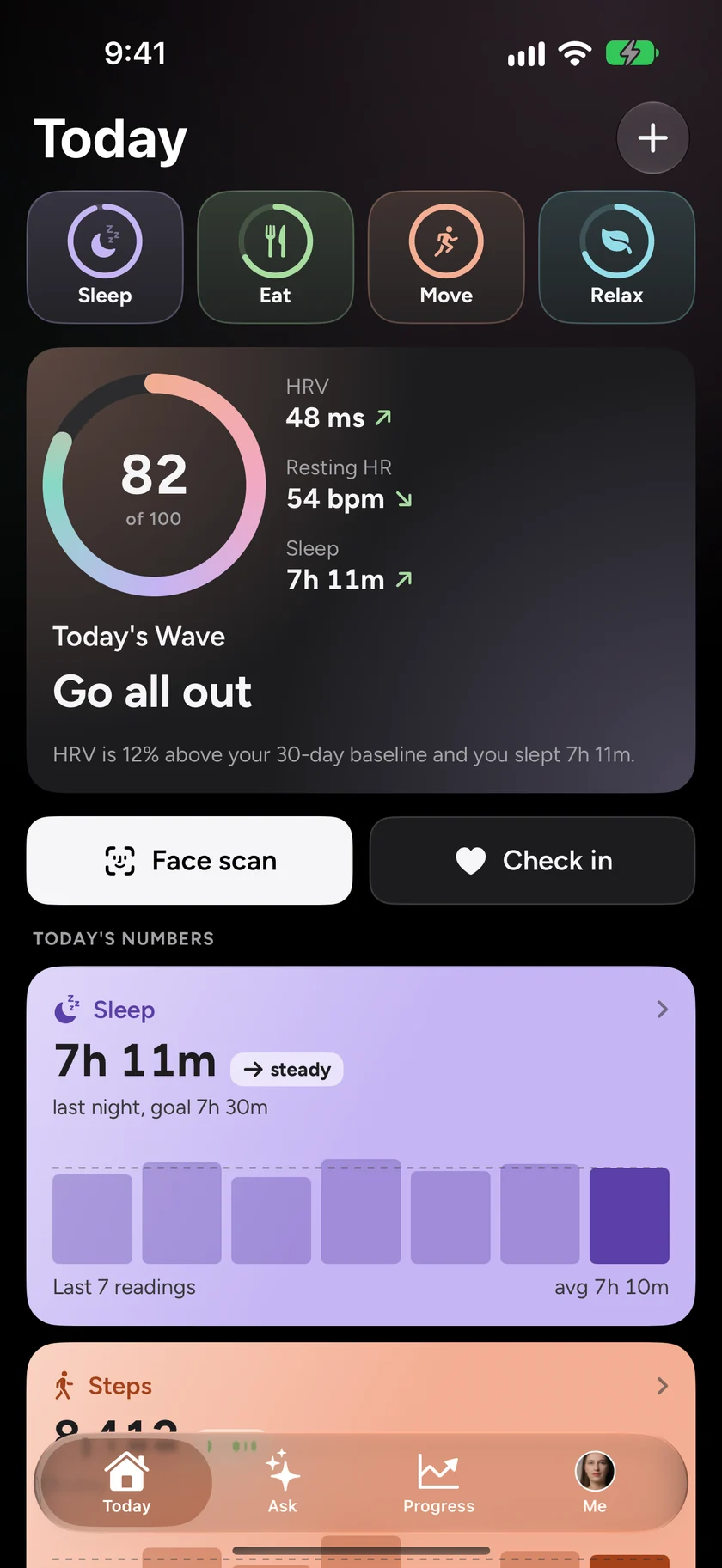
Then it clamps the total to 0 through 100 and gives you a call: 75 and up is “Go all out”, 45 to 74 is “Steady”, under 45 is “Take it easy”. The sentence underneath names the two inputs that moved it most. On the morning in the screen above, that is HRV sitting 12% above baseline and a night of 7h 11m.
Notice what the weights say. HRV gets the most room because it is the most sensitive sign of whether your nervous system has stood down. Resting heart rate is next, and it counts against you when it climbs, because a rising resting rate is one of the oldest signs that something is still being paid for. Sleep is split between your usual and an absolute floor, so a person who habitually sleeps six hours does not get full credit just for being consistent. Strain is asymmetric: a heavy yesterday can cost you up to ten, an easy one earns back only five. And your own sense of the day, the check-in, has a real say, because you know things a sensor does not.
You can disagree with any of those choices. That is the point. You can only disagree with a rule you can see.
Being honest when there is not enough
A formula also makes it easy to know when not to answer. Under seven days of baseline, Today’s Wave shows a range of ±8 and marks it thin, because a baseline built on four mornings is mostly luck. With no morning data at all, it says “Not enough yet” rather than inventing a number. A model asked for a score will generally give you one. Arithmetic with missing inputs simply has nothing to add up, and the app tells you so.
Where the AI does belong
None of this is a vote against AI. Wave AI is Claude from Anthropic, and it does a lot of work in the app. It just does a different kind of work: the kind where flexibility helps and a little variation costs nothing.
It turns “bench, three sets of five at 185, then my usual shake” into a workout and a meal, and nothing is saved until you tap Log. It reads a photographed lab sheet as a page, puts each value beside the spot it came from, and lets you keep or discard each one before anything reaches a chart. It answers plain-English questions in Ask from your own record. Those are language problems: messy input, many right ways to say a thing, a person checking the result.
The score is not a language problem. It is a measurement problem, and measurement wants the opposite qualities: rigid, repeatable, auditable, dull.
The rule underneath
It is a rule worth borrowing for anything you rely on. Let the clever system read, sort and explain. Let the plain one decide. When a number is going to tell you how hard to push your own body, you want to be able to ask it why and get the same answer every time.
Wave Wellness is free on the App Store and Google Play. Download it and see all of it working together today.
Wave is for general wellness and is not a medical device. Its score is an estimate built from your own data, not a clinical measurement.