Monday, Wednesday, Friday. That is what a good training week is supposed to look like, and for plenty of people with jobs and children it rarely does. The sessions slide, and by Friday the plan is a small private failure. Then Saturday brings a long ride or a two-hour hike, and it feels like it barely counts because it was not on the schedule.
It counts. Your heart and your muscles do not keep a calendar.
What the weekend warrior studies found
In 2017 a team led by Gary O’Donovan pooled health surveys from England and Scotland covering more than 63,000 adults and followed them for years (O’Donovan, 2017). People were sorted by how they reached the recommended amount of activity. Some spread it across the week. Others, nicknamed weekend warriors, packed it into one or two sessions.
Compared with inactive people, both groups had a clearly lower risk of dying over the follow-up, and the gap between them was small. The study had obvious weaknesses: weekend warriors were a small share of the sample, and everyone’s activity was self-reported.
Later work went after both. A study of about 350,000 American adults found the same pattern (dos Santos, 2022). A UK Biobank study measured activity with a wrist sensor for a week instead of asking, and found that people who did most of it on one or two days had about the same lower risk of heart attack, heart failure and atrial fibrillation as those who spread it out (Khurshid, 2023).
The fair reading: for the big long-term outcomes, the total matters more than the spacing. The US Physical Activity Guidelines say so in plainer words: 150 to 300 minutes of moderate activity a week, or 75 to 150 of vigorous. The unit in that sentence is the week.
What a good weekend cannot cover
A few honest limits before anyone cancels a Tuesday run.
- Big jumps hurt. Going from a quiet week to a hard Saturday is a sharp rise in load, and sharp rises are where strains come from. Build the long session up over months, and warm up for it.
- Strength is the exception the guidelines write down. They ask for muscle-strengthening work on two or more days a week. One heavy Sunday does not cover that alone.
- Sitting is a separate question. These studies compared patterns of exercise. Hitting the weekly total says nothing about how many hours you sat on the other five days.
None of that undoes the main finding. The weekend session works best as part of a week, not as a rescue for one.
Why the day is the wrong unit
The bigger cost of thinking in days is what a missed day does to the plan.
When the unit is the day, a skipped Wednesday is a failure, and it sits there for the rest of the week. Two of those and the plan looks broken, which is usually when people stop. When the unit is the week, a skipped Wednesday is a gap with four days left to fill. Same body, same total, but one framing keeps you going and the other talks you out of it. Habits survive when you can recover from a miss, and counting by the week makes recovery the default.
How Wave counts a week
In Wave Wellness, the workouts-a-week goal counts the sessions you logged in the last seven days. It is a rolling seven days, so there is no Monday reset and no week that is lost by Wednesday. Steps and sleep goals work the same way, averaged over the last seven days. A Saturday hike, a Sunday ride and a short run midweek is three sessions and On target, exactly as Monday, Wednesday and Friday would be.
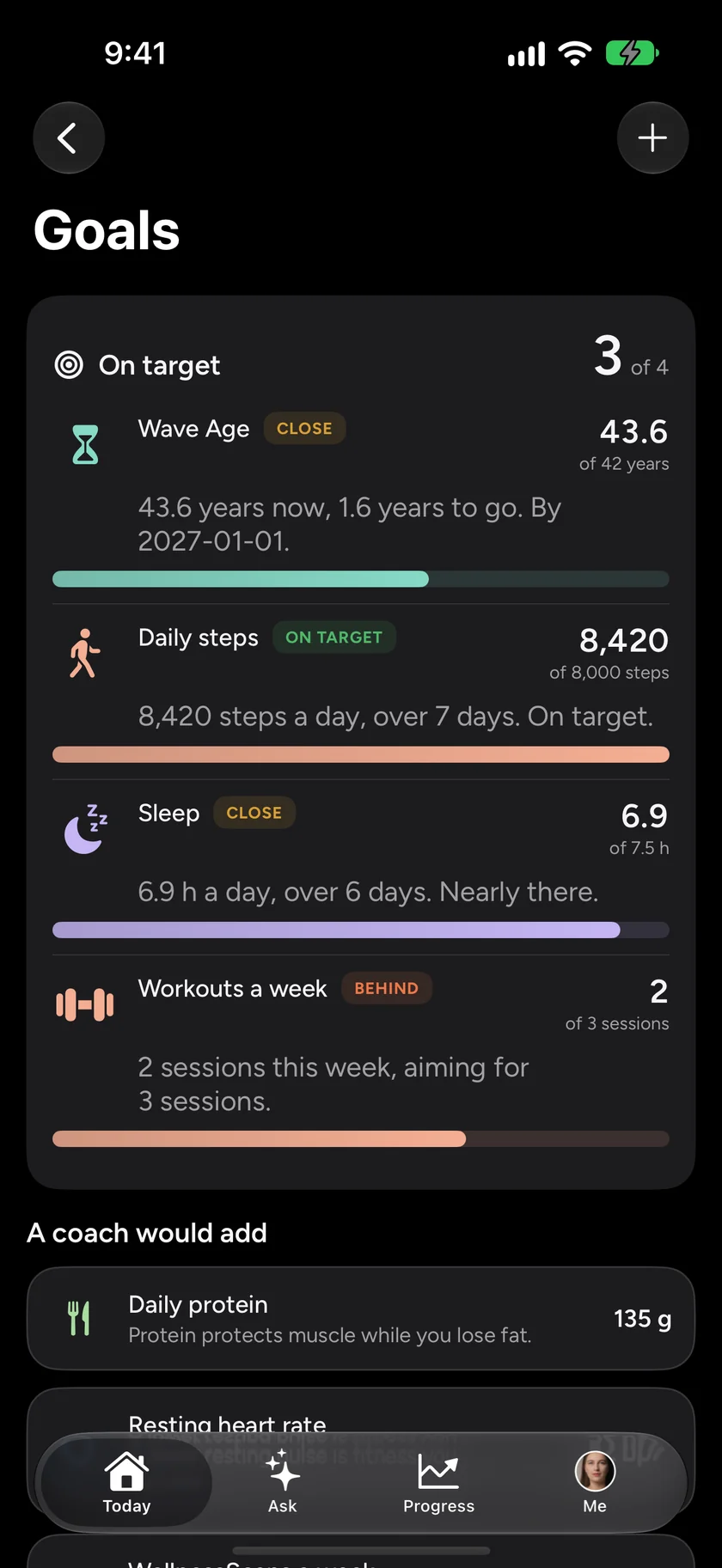
Any logged session counts, a Walk included. If you wear an Apple Watch, its workouts arrive in Move on their own. If not, one sentence to Wave AI, “two-hour hike, steady pace”, becomes a session, and nothing is saved until you tap Log. Move shows the week as sessions, time and weight lifted, and each session can carry a “How hard, 1 to 10” rating, handy for noticing when the weekend outing has become the hardest thing you do all week.
Wave Age takes the same weekly view in its lifestyle half. Strength training is read as sessions a week, with one or two a week worth about 15 percent lower risk in the research it cites (Momma, 2022), and cardio minutes count whether they came from a run or a walk.
One place does read the day: Today’s Wave. Yesterday’s strain, judged against the week before, can move the morning score up to ten points down or five up, so the morning after a big Saturday may say Steady or Take it easy. That is not a verdict on your week. The goal reads the week; the score reads the morning. Both are right about different things.
What it cannot tell you
Wave counts sessions and minutes. It cannot tell whether the jump from a quiet week to a hard Saturday is too much for your knees, and a stacked week and a spread week look the same on the goal. How Sunday morning feels still has a say.
The idea works without any app. The next time a midweek session falls through, do not write off the week. Ask what the total can still be by Sunday.
Wave Wellness is free on the App Store and Google Play. Download it and see your own week of training today.
Wave is for general wellness and is not a medical device. It does not diagnose or treat anything; talk to a doctor before taking up hard exercise if you have a heart condition or have been inactive for a long time.