Two people run the same five miles at the same pace. Their watches record nearly the same session: the same distance, the same minutes, similar heart rates. One finishes still talking. The other finishes bent over with hands on knees, after four hours of sleep and a long week.
On paper, those are the same workout. The only instrument that caught the difference is the one almost nobody records: how hard it felt.
The oldest instrument in training
In the 1960s and 1970s, the Swedish psychologist Gunnar Borg set out to measure something that sounds unmeasurable: perceived exertion. His first scale ran from 6 to 20, numbered so that, for a healthy young adult doing steady work, the rating times ten lands roughly near heart rate. He later built a simpler 0 to 10 version, the CR10 scale (Borg, 1982), which is the one most coaches use today.
The reason it works is that effort is not a vague feeling layered on top of the real data. It is your brain’s running summary of nearly everything at once: heart rate, breathing, the burn in the working muscles, heat, how you slept, what the week has taken out of you. A watch measures a few of those directly. You perceive all of them, every second, for free.
So a rating of effort is not the opposite of a measurement. It is a different kind of measurement, with a different set of strengths.
Minutes times effort
The idea became genuinely useful when Carl Foster and colleagues turned it into a number you can add up (Foster, 2001). About half an hour after a session, rate the whole thing from 0 to 10. Multiply by the minutes. That product is the session’s load.
An hour at a 7 is 420. Half an hour at a 4 is 120. Add a week of sessions and you have a weekly load you can compare with last week’s, built from a stopwatch and one honest number. Foster’s group compared it with a load measure built from heart rate zones and found the two tracked each other well, and the method has since spread widely, partly because it is cheap enough to collect from an entire team every day.
Lifting has its own version. Heart rate says little about a heavy set of five, so lifters rate effort by what was left in the tank: a 10 means nothing left, a 9 means one more good rep, an 8 means two. A scale built on those “reps in reserve” was tested in lifters and tracked how close they really were to failure reasonably well (Zourdos, 2016). It also turns a vague rule of strength training, “train hard,” into a usable one: finish most sets with one to three good reps still in you.
What effort catches that a watch misses
Effort earns its place by noticing things the other numbers cannot.
- The same session feels harder than usual. Often the first sign that sleep, stress or a long week is costing you.
- The same weight feels easier. That is progress, showing up before you add a plate.
- A strength day, where heart rate barely describes the work.
- A session with no watch at all, which is most of them for a lot of people.
It has honest limits. It is subjective, so it drifts with mood. People new to training are less consistent at rating it. And a 7 means something different to you than to the person on the next bench. None of that matters much, as long as you compare yourself with yourself: the same scale, rated the same way, at about the same time after the session. The trend inside one person is the useful part. Comparing your 7 with anyone else’s is not.
Where Wave keeps it
In Wave Wellness, a session you log in Move has an optional “How hard, 1 to 10” beside the minutes and the name. Strength sessions keep their sets, lifts and effort together, and the effort travels with the session, so a push day in your recent sessions reads as six sets, three lifts, effort 8.
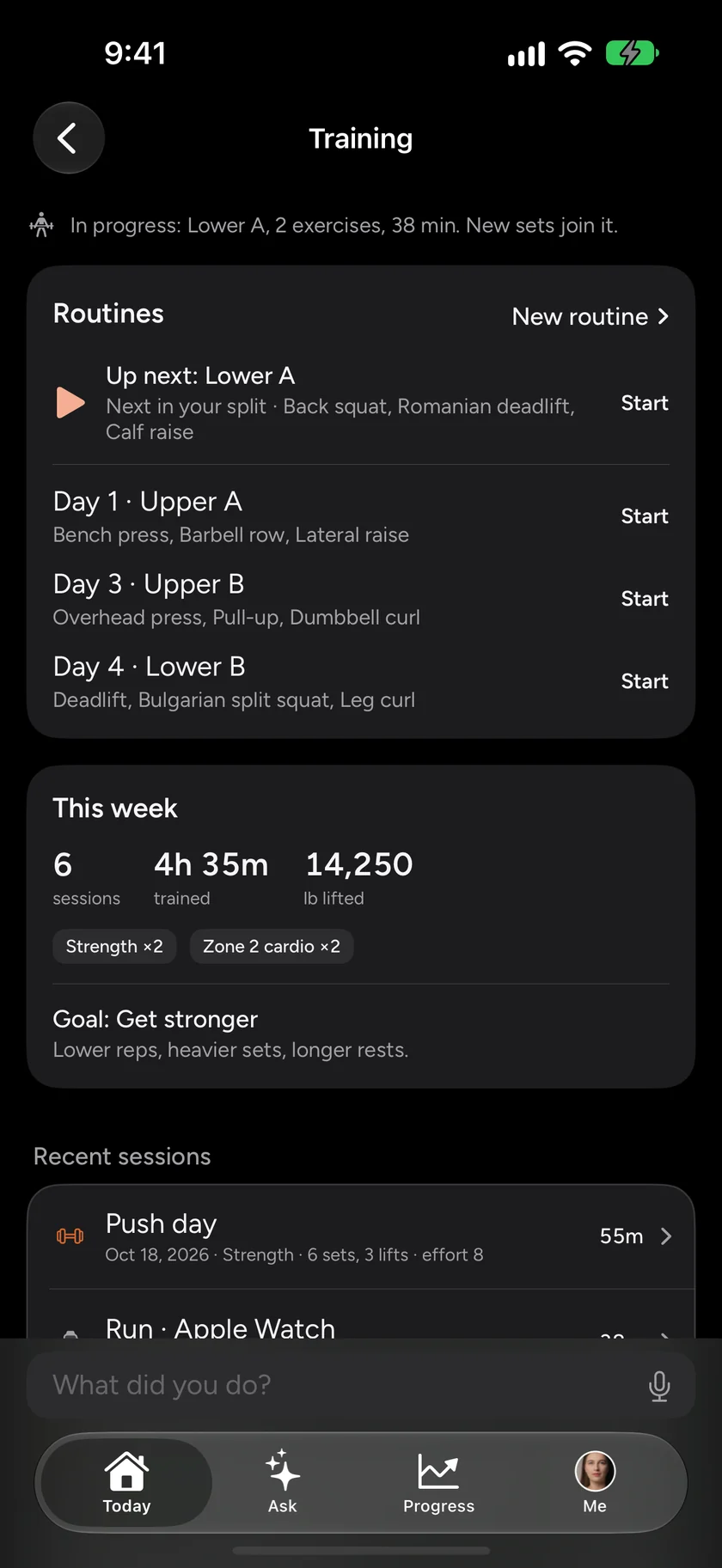
That line is the point. Every routine opens with the weights you lifted last time, and the effort sits beside them, so you can see the two together: 185 for five was an 8 a month ago, and today it was a 6. The bar has not moved yet. You have.
Here is what it does not do. Your rating is a record, not an input to the daily score. Today’s Wave takes yesterday’s strain from your wearable, or from a logged session’s minutes when no strain figure exists, and your effort number is not part of that arithmetic. So it is yours to read, and it is worth reading: it is the only line in your log that knows how the session actually went.
The habit works with a notebook too. Tonight, after whatever you did, write one number from 1 to 10. Do it again tomorrow. In a month you will have something no watch can give you.
Wave Wellness is free on the App Store and Google Play. Download it and see your own sessions today.
Wave is for general wellness and is not a medical device. It does not diagnose or treat anything; talk to a doctor before starting or stepping up a training program.