Here is a common morning. Your training app says it is leg day: five sets of squats, heavier than last week. Your sleep app, in a different corner of your phone, says you slept five hours and woke three times. Neither of them knows the other exists. So the plan stays the plan, and you either grind through a session your body was not ready for or skip it and feel guilty.
The problem is not either app. Each one is good at its job. The problem is that the decision you actually face, how hard to go today, needs both of their answers at once, and nobody is putting them in the same room.
The same workout is not the same dose
A training session is a stress you apply on purpose. You get fitter not from the session itself but from recovering from it. That makes a workout less like a fixed quantity and more like a dose of medicine, where the effect depends on the state of the person taking it.
Five sets of squats after a full night’s sleep and a quiet week is a productive stimulus. The same five sets after a short night, in a week that already had two hard sessions and a work deadline, is a much bigger hit, even though the logbook records them identically. Short sleep raises how hard effort feels and blunts performance; that much is well established. Accumulated load without matching recovery is how people end up stalled, sore and cranky rather than fitter.
Coaches have known this forever, which is why good ones ask how you slept before they tell you what to lift. Some training studies have taken it further, adjusting each day’s session to a morning heart-rate variability reading rather than following a fixed calendar, and found results at least as good as the fixed plan. The principle is simple: the right session depends on the plan and on the person, and you need to see both.
Two records, one question
What makes this hard in practice is plumbing. Your watch records workouts. A ring or strap records sleep and HRV. A notes app or a lifting app holds your sets. Each keeps its own history in its own format, and the question “given what I did this week and how I slept last night, what should today be?” falls in the gap between them.
The fix is not a smarter training app or a smarter sleep app. It is one timeline, where yesterday’s work and last night’s recovery sit next to each other and get weighed together.
How Wave puts them together
Wave Wellness keeps training and recovery in one record and reads them against each other every morning in Today’s Wave, the daily score.
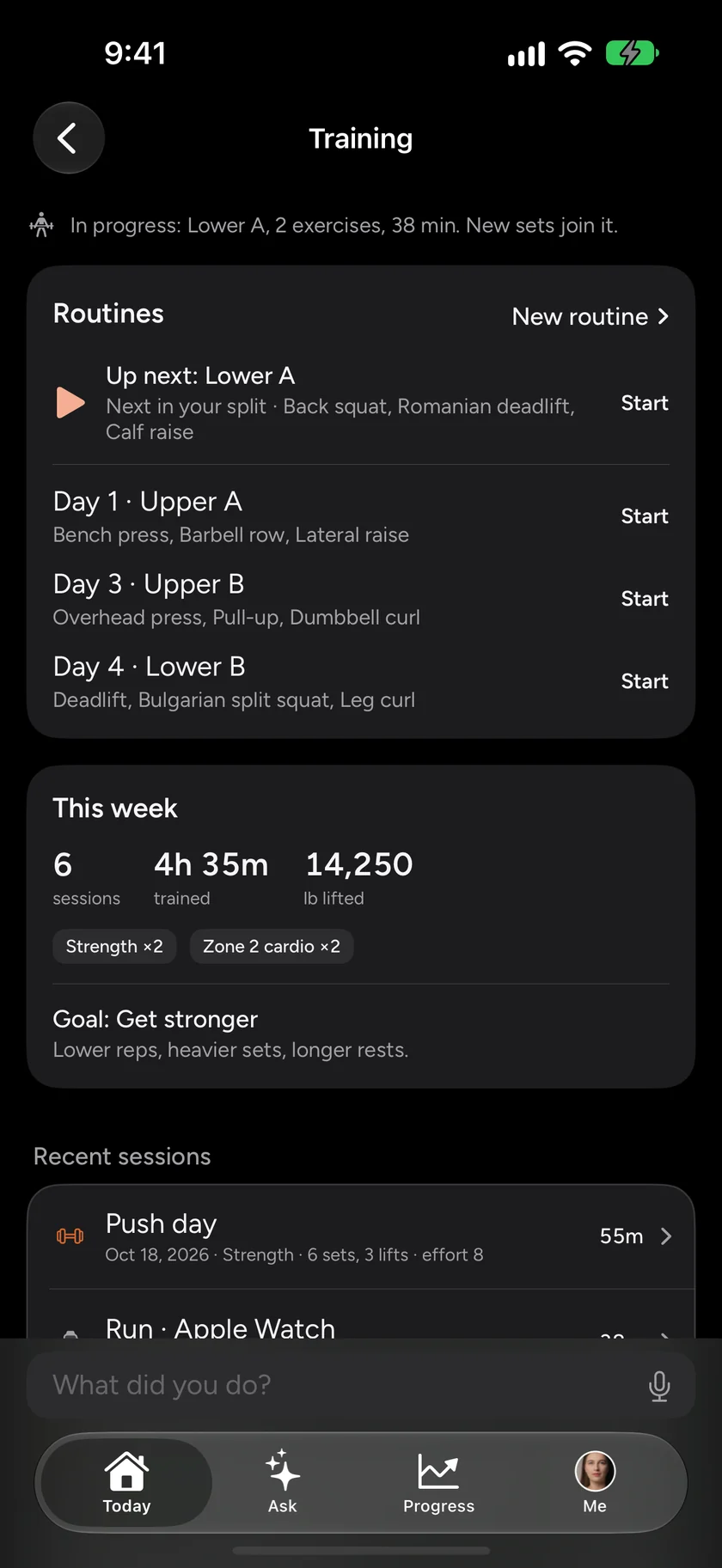
The training side arrives on its own where it can. Apple Watch workouts come in automatically. Strength sessions keep their sets, lifts and effort, logged in a sentence if you like (“squat, five sets of five at 225”), and every routine opens with the weights you lifted last time, so you never start a session guessing.
The recovery side comes from whatever you have: HRV, resting heart rate and sleep from Apple Health or WHOOP, or from the morning WellnessScan if you wear nothing at all.
Then the score does plain arithmetic, with no AI in it. It starts at 60 and adds signed points:
- HRV against your own 30-day baseline, up to 30 points either way
- resting heart rate against your baseline, up to 20, where a rise counts against you
- sleep against your usual and against seven hours, up to 20
- yesterday’s strain against the week before, from 10 points off to 5 points on
- your check-in mood and energy, up to 15
That strain line is the meeting the two apps never had. Yesterday’s session is judged against the week before it, so the same workout counts for more after a quiet stretch than in the middle of a busy block. And it sits in the same sum as your HRV and sleep, so a big session followed by a good night reads very differently from a big session followed by a bad one.
The result is one of three calls: Go all out at 75 and above, Steady from 45 to 74, Take it easy below 45. A sentence names the two inputs that moved it most, so you can see whether it was the squats or the five hours.
What it does not do yet
Be clear about the edges. Today’s Wave tells you how ready you look; it does not rewrite your program. It does not know you have a race on Saturday or that this is a planned overload week. It is a second opinion to set beside your plan, not a coach.
It also needs history. With fewer than seven days of baseline, it shows a range marked thin, and with no morning data it says “Not enough yet” rather than guessing.
Two of the obvious next steps are already here. Start a routine and every lift opens at the weight your own log says you earned, with one line saying why, and Today’s Wave decides whether today adds a plate: a take-it-easy morning never does. On a go-all-out morning it names the one top set that would beat your best. That is arithmetic over your log, not AI. Food targets that follow your training are still on the way.
What is live is the part most people are missing: the hard session finally hears about the bad night, every morning, in one number you can check before you lace up.
Wave Wellness is free on the App Store and Google Play. Download it and see your own training today.
Wave is for general wellness and is not a medical device. Talk to a doctor before starting a new training program if you have a heart condition or any symptoms during exercise.