Watch someone load a bar on a Tuesday night. They stand there for a second, hands on their hips, trying to remember. Was it 135 last week, or 145? Five reps or six? They pick the number that feels right, which is usually the number they lifted the week before, and the week before that.
That pause is where a lot of strength training quietly stalls. Not from lack of effort, and not from a bad program. From a gap in memory.
Strength is built on “a little more”
Muscle adapts to a demand it has not met before, and it stops adapting once the demand becomes routine. That principle has a name, progressive overload, and it is the one idea every sound strength program shares, whatever else they disagree about. The load goes up, or the reps do, or the sets do, or the same work gets done with better form and less strain. Something has to move, a little, over the weeks.
The important word is “little”. Nobody adds fifty pounds to a squat in a month. Progress in the gym is a long series of small steps: five more pounds, one more rep, one more set, the same weight that felt like an 8 out of 10 now feeling like a 7. Each step is small enough to be invisible on its own. Stacked over a year, they are the whole result.
And small steps have a problem. You cannot take one without knowing exactly where you are standing.
Memory is a bad training partner
Ask yourself what you lifted for your third set of rows nine days ago. Most people cannot say, and there is nothing wrong with them. Nine days, a dozen meals, two bad nights and a work deadline sit between that set and now. The detail was never important enough to keep.
So people fall back on the safe guess. If you are not sure whether you did 135 or 145, you load 135, because failing a lift you thought you could make is unpleasant and slightly embarrassing. Repeat that guess for a few months and you have a program that never actually progresses. The sessions feel productive. But the demand never rises, so the body has no reason to change.
The opposite mistake happens too: a good day, a confident jump, a number well past anything you have done, a bad set and a sore shoulder. Both errors come from the same place. You were choosing a weight without the one fact that matters most, which is what you did last time.
This is why serious lifters have always carried a notebook. It is the cheapest piece of equipment in the room, and the only one that tells you what to do next.
A log that opens on the last session
The notebook has two weaknesses: you have to write in it, and you have to remember to open it to the right page. Wave Wellness is designed around both.
Writing it down is one sentence. In Ask, or in any area of the app, you can say or type “bench, three sets of five at 185” and Wave AI turns it into a strength session with its sets. Nothing is saved until you tap Log.
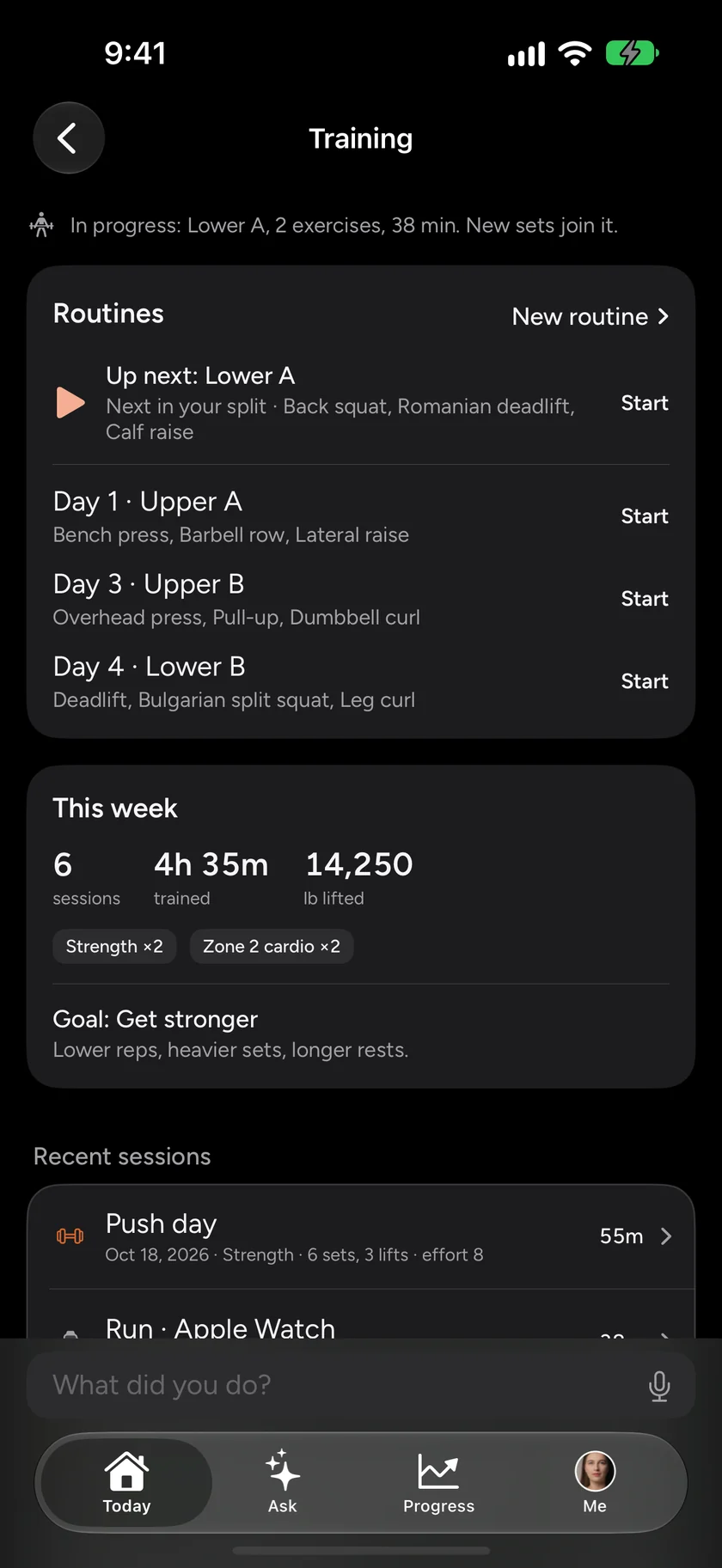
Opening to the right page is automatic. In the Move area, every routine opens with the weights you lifted last time. You do not search your history in the middle of a set, or scroll back through a week of entries. The number you need to beat is on the screen before you pick up the bar. Whether you add five pounds, add a rep or repeat the session stays your call; what changes is that you are making it from a fact instead of a feeling.
The rest of the record fills in around it. Each strength session keeps its sets, lifts and effort, so you know not just what you lifted but how hard it felt. Apple Watch workouts arrive on their own, and the week adds up to sessions, time trained and weight lifted.
Because it all lives in one record, the same log that tells you what to lift also sits beside how you slept and how you recovered. Today’s Wave, the daily score, already reads your sleep, HRV and resting heart rate, and how much strain yesterday carried compared with the week before. A session that felt heavier than the numbers say it should have is worth looking at next to a short night.
What the log does not do
Be clear about the edges. Wave records what you did and puts it in front of you next time. It does not write your program, and it does not know that your coach has planned a light week, or that your knee has been grumbling. Those are judgments for you, or for someone who can watch you lift.
A log is also only as good as what goes into it. A watch can tell that you trained and for how long; the sets and the weights come from you. One sentence after a session is a small ask, but it is still an ask, and a gap in the log is a gap in the memory it was meant to replace.
And the log will not make a weight lighter. It just removes the guess. On the days you add five pounds, you will know it was five, and that you earned it. On the days you repeat last week, you will know that too, and why.
The quiet advantage
Most of what moves a strength program is unglamorous. Showing up, eating enough protein, sleeping, and adding a little at a time. The last one is the easiest to lose track of, because it depends on remembering a number that never seemed important when you lifted it.
Keep the number, and the next small step is obvious. Lose it, and you can train hard for a year and stand still.
Wave Wellness is free on the App Store and Google Play. Download it and see your own training today.
Wave is for general wellness and is not a medical device. If you have a joint, heart or blood pressure condition, talk to a doctor before adding load.