Count the taps the next time you log a lunch in a typical food app. Open it, find the meal, search “chicken salad”, scroll past forty versions, pick one that looks close, guess the grams, adjust the serving, add the dressing separately, save. Twenty taps is not an exaggeration, and that was the easy meal. Now do it three times a day, every day, while your lunch gets cold.
Most people who start a food log stop within the first few weeks. The usual story is that they lost motivation. The better story is that the log asked for more than the information was worth to them on a busy Tuesday, and on Wednesday they skipped it, and on Thursday the gap made it feel pointless.
The problem was never willpower
Self-monitoring is one of the most consistent findings in behavior research: people who keep track of what they eat tend to do better at whatever they are trying to change than people who do not. Burke and colleagues reviewed the literature on it in 2011 and found the link again and again, with a detail that matters more than the headline: the people who did best were the ones who kept it up.
That shifts the question. If the value of a log comes from keeping it, then the most important property of a logging tool is not precision. It is cost. Every tap, every search, every “how many grams was that” is a small tax, and people stop paying taxes that feel larger than the return.
This is also why a perfect log is a trap. Weighing every portion produces beautiful data, briefly. A rough log that is ninety percent right and kept for a year tells you far more: which weeks your protein falls off, what your weekends really look like, whether the late snack is a habit or a story you tell yourself. Patterns live in volume, and volume comes from ease.
Say it the way you would say it to a friend
Wave Wellness starts from that premise. In Ask and in every area of the app there is one box, and you can speak into it or type: “bench, three sets of five at 185, then my usual shake”. Wave AI turns that sentence into entries, a strength session with its sets and a meal with its protein, the way a friend writing it down for you would.
It handles most of what a day contains: workouts with sets, meals with protein, water, supplements, sleep, weight, even a whole new routine described in a sentence. Voice becomes text on the device where it can, and Wave receives the text, never the audio.
Three design choices keep it honest.
It asks, but rarely. At most two follow-up questions, and only when the answer would change the entry. “Had a chicken salad for lunch” earns one: how big was it? Tap A side, A bowl or A big bowl, answer in your own words, or skip it and keep the best estimate.
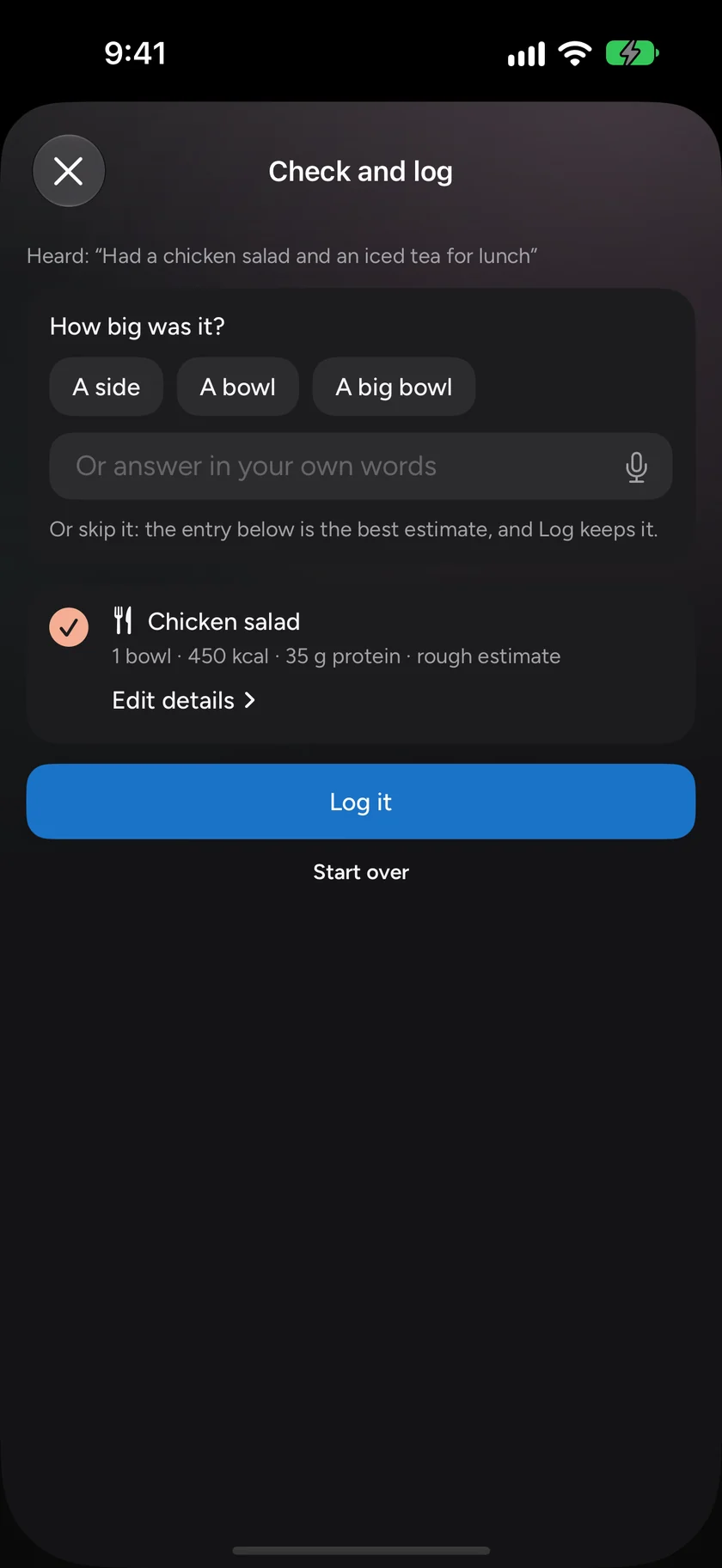
Nothing is saved until you tap Log. Wave AI drafts; you decide. You see exactly what it understood, labeled as a rough estimate where it is one, with Edit details a tap away. A misheard “fifteen” never quietly becomes “fifty” in your record.
It learns your usuals, and you can make it forget. Most people eat the same handful of breakfasts. Once Wave AI knows “my usual breakfast”, that becomes three words instead of five ingredients. Profile lists everything it remembers about your habits, and you can delete any of it.
When words are not the easy way
Sometimes a picture is quicker than a sentence. The + reads a photo of a plate, a photo of a nutrition label, or a barcode, which is looked up in Open Food Facts, the open food database. A packaged snack becomes one scan. A restaurant plate becomes one photo and a check.
The point is not that every route is perfect. It is that there is always a route that costs a few seconds, so the day you are tired is not the day the log breaks.
Wave AI is powered by Claude from Anthropic, and Anthropic does not train on what you tell it.
What a rough log can and cannot do
Be clear about the trade. A sentence-based entry is an estimate. “A bowl” of salad covers a wide range of calories, and a photo of a plate cannot see the oil in the dressing. Research on self-reported eating has long found that people tend to underestimate what they eat, and no app removes that by being friendly. If you need gram-level accuracy for a reason, a kitchen scale is still the instrument.
What a rough log does well is direction and pattern. If your entries are consistently a little off, they are off in the same way every week, so the changes still show: protein drifting down when work gets busy, more caffeine after short nights, the weeks your eating looks like your plan and the weeks it does not. Wave’s Eat area sets that against suggested targets and four weeks of history, so the pattern is visible without you doing the arithmetic.
There is a quieter benefit too. When logging costs a sentence, you log the bad meals as well as the good ones. A log that only records your best days is a diary of intentions. A log that records the drive-through on the way home is data.
The real measure of a food log
Ask whether you will still be using it in March. That is the only accuracy test that matters, because the most precise log in the world tells you nothing about the weeks it was not kept.
So make it cheap. One sentence, one photo, one question at most and then Log. An imperfect log you keep beats a perfect one you abandon, every time.
Wave Wellness is free on the App Store and Google Play. Download it and see your own meals today.
Wave is for general wellness and is not a medical device. Its nutrition figures are estimates; talk to a doctor or a registered dietitian about any diet tied to a medical condition.