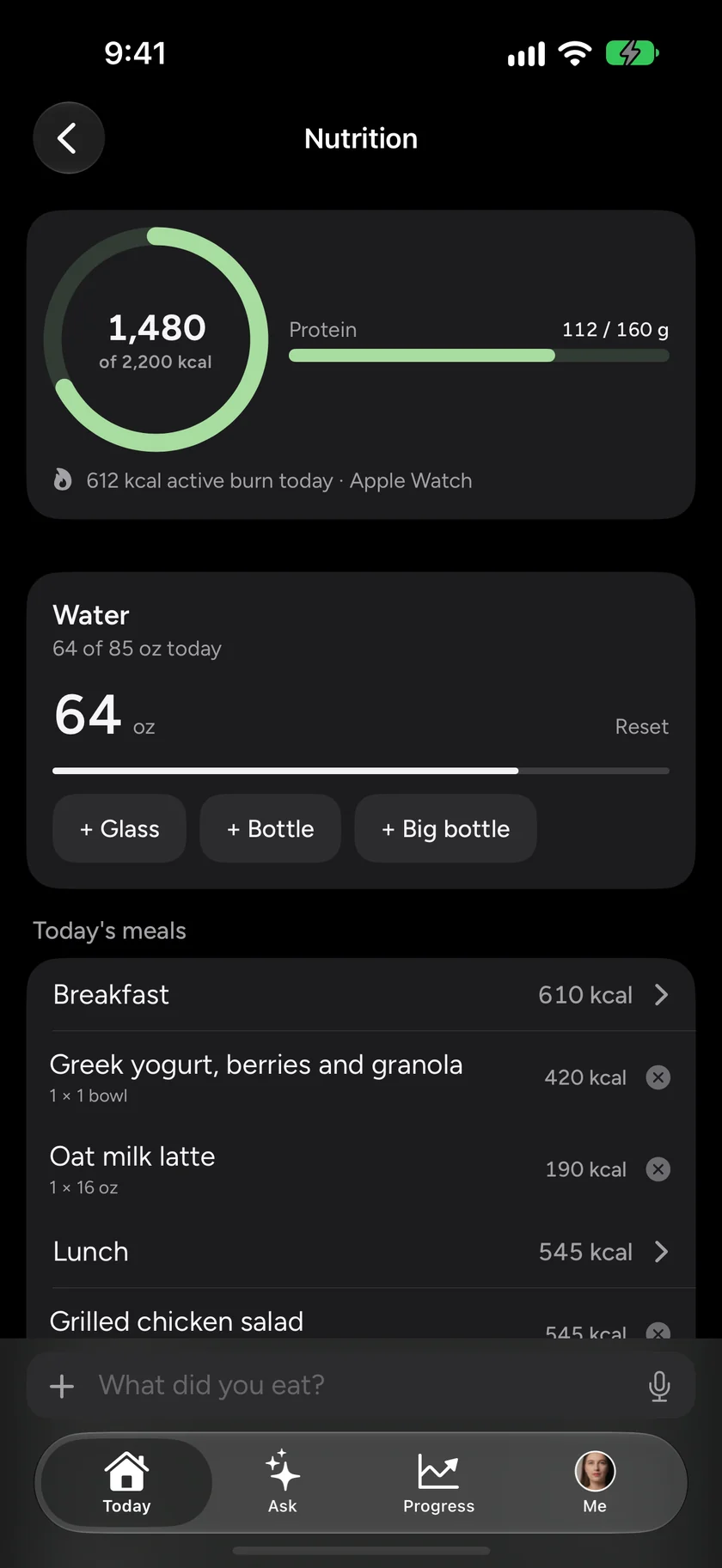
The ring on a nutrition screen says 2,050 of 2,200. Both numbers look exact to the calorie. Neither one is. The first is a sum of label values and portion guesses. The second is a formula multiplied by another guess about how much you move. You are measuring an estimate against an estimate, and then making decisions in the gap between them.
That is not an argument for ignoring calories. It is an argument for knowing what kind of number they are, because you use a rough number very differently from a precise one.
The label is a rounded average
Most calorie counts on food still rest on work Wilbur Atwater did in the 1890s. He fed people measured diets, measured what their bodies did not absorb, and settled on round figures: about 4 calories per gram of protein, 4 per gram of carbohydrate, 9 per gram of fat. Those factors are averages across foods and across people. They are good averages. They are still averages.
For some foods they are wrong in a predictable direction. When USDA researchers fed people measured amounts of almonds and checked how much energy was actually absorbed (Novotny, 2012), the almonds delivered roughly a fifth fewer calories than the standard factors predicted, because much of the fat stays sealed inside cell walls the gut never fully breaks open. Nuts are the famous example, not the only one. Whole, fibrous, lightly cooked foods tend to give up less than the label suggests; finely processed foods give up closer to all of it.
Then there is the law. In the United States, the FDA’s labeling rule lets the actual calories in a packaged food run up to 20 percent above the declared value before the label counts as out of compliance. Most labels are closer than that. The rule simply tells you how much slack the system was built to tolerate.
And all of that assumes you weighed the portion. Most people eyeball it, and eyeballs are generous to their owners.
Your gut and your watch add their own
Absorption varies by person and by meal. The same bowl of food can yield a different amount of usable energy depending on how it was cooked, what it was eaten with, and the bacteria in your gut. None of that is on the label, and none of it is visible to any app.
The other side of the ledger is shakier still. A Stanford team tested seven wrist devices against lab measurement (Shcherbina, 2017) and found that heart rate was mostly good while calorie burn was not: no device estimated energy expenditure to within 20 percent, and some were off by far more. A watch infers burn from heart rate, movement and your profile. It is a reasonable model of you. It is not a meter.
The target is arithmetic on all of it
Wave Wellness suggests a calorie target the standard way, and the arithmetic is worth seeing, because that is where the humility lives.
It starts with the Mifflin-St Jeor equation, which estimates the energy your body uses at rest from weight, height, age and sex. For a 40-year-old man who weighs 80 kg and stands 178 cm, that comes to about 1,720 calories a day. Wave multiplies by 1.4, a stand-in for a lightly active life, to get roughly 2,400. To lose, the suggestion is 400 below that; to build, 250 above. Protein is set at 1.6 g per kg of body weight (1.8 when building), fat at 30 percent of calories.
Every step is defensible. Every step is also an estimate. Resting equations like this one land within about 10 percent of a lab measurement for most people and miss by more for some. And the 1.4 is a guess about your days: call it 1.3 or 1.5 instead, both plausible for a desk job and a daily walk, and the same man’s maintenance moves from about 2,230 to about 2,580.
That spread, roughly 350 calories, is nearly as large as the 400-calorie deficit he is trying to create. That is the whole point. On day one, no calorie target can tell you whether you are eating 400 below maintenance or right at it. Only the following weeks can.
Let the trend be the referee
So treat the target as a starting line, not a verdict. Eat to it, roughly, for two or three weeks. Weigh yourself under the same conditions each time (morning, after the bathroom, before food) and watch the direction of the weeks, not the number on any single morning. Daily weight swings by a kilo or more with water, salt and whatever is still in your gut. A trend across weeks irons most of that out.
If the trend is heading where you wanted at about the pace you wanted, the target is right for you, whatever the formula said. If nothing has moved after three weeks, take 100 to 200 calories off and give it three more. If you are losing faster than you meant to and feel flat, add some back. The scale is not a perfect instrument either, but it is the only one in the chain that measures the outcome instead of predicting it.
Wave keeps the parts of this honest where it can. The active burn from your watch is shown on its own line with its source named. The four-week history counts logged days only, and a gap is a day you did not log, never a zero, so a missed Saturday does not pass for a fast. You can tell Wave AI your weight in a sentence, set a body weight goal, and the goal reads On target, Close or Behind against the number you chose. The suggested targets are suggestions: when your own trend disagrees with them, change them.
What Wave does not do is move the target for you as the weeks come in. That correction is yours, and it takes about a minute every few weeks.
Precision you can do without
The quiet gift in all this uncertainty is permission. You do not need to log the olive oil to the gram, because the system you are logging into could not use that precision anyway. Rough logging on most days, plus an honest look at the trend every week or two, gets nearly all the value. Chasing exact numbers on top of inexact inputs mostly buys stress.
Calories are a good map drawn from a long way off. Use it to start walking, then trust the ground.
Wave Wellness is free on the App Store and Google Play. Download it and see your own meals today.
Wave is for general wellness and is not a medical device. Talk to a doctor or a registered dietitian before making a large change to how you eat.