You have looked at your teeth thousands of times. Brushing, flossing, checking for spinach, smiling at a mirror in a restaurant bathroom. And for all that looking, you could not say with any confidence whether your gum line sits where it did two years ago, or whether that front tooth has turned a degree, or whether the shade has drifted. You see your smile every day, and that is precisely the problem.
The eye is built to miss slow change
Psychologists call it change blindness. In one well-known experiment, people giving directions to a stranger often failed to notice when, after a brief interruption, the stranger was replaced by a different person (Simons and Levin, 1998). A related effect is even more relevant to your mouth: when a change happens gradually enough, with no single moment where it jumps, people often miss it entirely while staring straight at it.
Your brain is not a camera. It keeps a rough model of what familiar things look like and updates that model quietly, every time you look. Each morning’s smile gets compared with yesterday’s, which looked almost exactly the same, and the model absorbs the difference. Over months, the small differences add up to a real one, and you never see it, because there was never a day when it happened.
Most of what changes in a mouth changes this way. Teeth drift a little over the years. Gums can creep. Stain builds up in layers, a coffee at a time. Edges wear. None of it announces itself, and the person least likely to notice is the one who looks every day. Often the first to notice is a dentist who sees you twice a year, or a photo from five years ago that suddenly looks like someone else’s smile.
The fix is a fixed yardstick
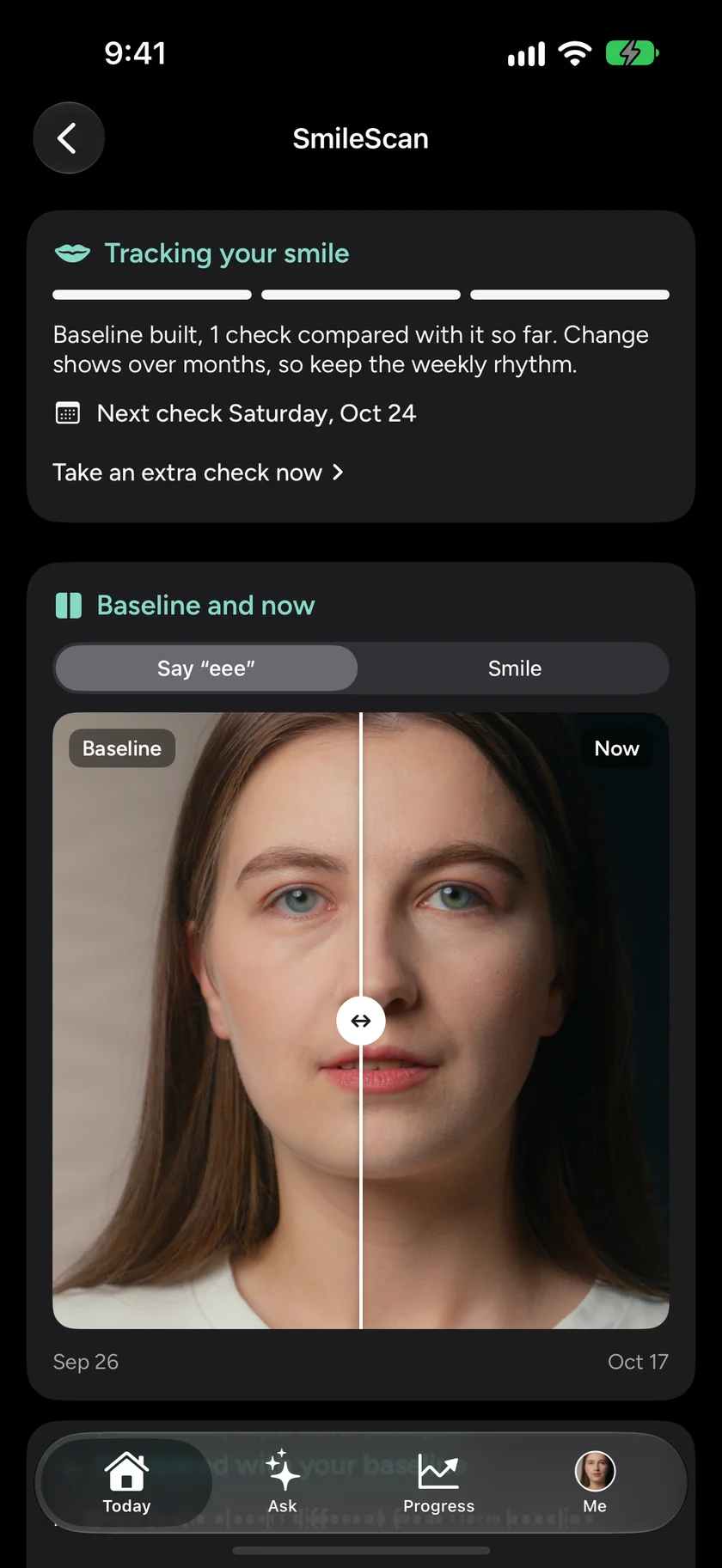
If memory updates itself, the answer is to stop relying on memory. Compare today not with yesterday, but with a fixed point that does not move: a photo of your own smile from before. That is the idea behind the SmileScan in Wave Wellness.
It asks for two photos once a week: a relaxed smile and a “say eee” that shows the teeth edge to edge. Weekly is deliberate. Daily photos would be too close together to show anything except noise. A weekly rhythm builds a series spaced far enough apart that slow change has room to appear, and a check only counts toward that rhythm when it is six or more days after the last (you can take extras whenever you like).
The first three weekly checks build your baseline. From week four on, each new check is compared with it across six areas:
- tooth position
- gum line
- gum color
- shade and stain
- visible buildup
- chips and wear
Each area gets one of four answers: the same, a little different, different, or cannot tell. The comparison is always with you. There is no population of “average” smiles behind it and no ideal it is scoring you against. A slightly crooked tooth that has been slightly crooked since you were twelve is simply what the same looks like.
Getting the same photo twice
Comparing photos only works if the photos are comparable. A different angle can make a tooth look rotated; different light can make a shade look darker. So the hard engineering problem in the SmileScan is not looking at teeth. It is taking the same picture twice.
Two things help. When you line up, your baseline photo is shown faintly over the camera, a ghost of last time, so you can match the angle and distance by eye. And you do not have to tap anything: the camera fires itself once you are lined up, so the shot is not knocked off by your thumb.
The third thing is the most important, and it is an answer that is easy to leave out: “cannot tell.” If this week’s angle or light does not match the baseline closely enough, the honest response is not a guess. It is to say the comparison could not be made. A wrong “different” would worry you for nothing; a wrong “same” would reassure you for nothing. “Cannot tell” is what a careful observer says, and the SmileScan says it.
A baseline that knows when to start over
Some changes are supposed to happen. After braces or aligners, the whole point is that tooth position changed. After whitening, shade has changed on purpose. After dental work, an edge or a surface may look different because someone made it so. Comparing against the old baseline would just keep reporting the change you paid for.
So the SmileScan lets you start a fresh baseline after braces, aligners, whitening or dental work. Three new weekly checks, and the yardstick resets to the smile you have now.
What it will and will not tell you
The SmileScan is never a diagnosis. It does not name conditions, and condition words are stripped out of its notes, because a camera on a phone is not a dental exam and should not talk like one. What it does is describe what looks different from your own baseline, in plain words, and when something is worth a word with a dentist, it says so.
That is a narrow job, and it is meant to be. A dentist with a mirror, a probe and an X-ray sees far more than any photo. What a dentist does not have is a picture of your smile every week between visits. The SmileScan is that picture, so the slow changes you were never going to see in the mirror at least get noticed by something, and you walk into your next appointment with a question instead of a surprise.
It runs on iPhone, Android and the web, with the same history on each.
Wave Wellness is free on the App Store and Google Play. Download it and see your own WellnessScan today.
Wave is for general wellness and is not a medical device. It does not diagnose or treat anything; talk to your dentist about any change in your teeth or gums.