The signal the WellnessScan is looking for is smaller than the flicker of a light bulb. Every heartbeat pushes a pulse of blood into the tiny vessels of your face, and for a moment your skin absorbs a little more light, mostly green, then gives it back. The change is a fraction of one percent of the light coming off your skin. Everything else the camera sees in those forty seconds (the lamp, the window, your head drifting a millimeter, the camera adjusting itself) is larger.
So the hard part of reading a pulse from a face is not seeing the heartbeat. It is throwing away everything that is not the heartbeat. This is a look at how the scan in Wave Wellness does that, step by step, and where it stops being able to.
Three patches, one heartbeat
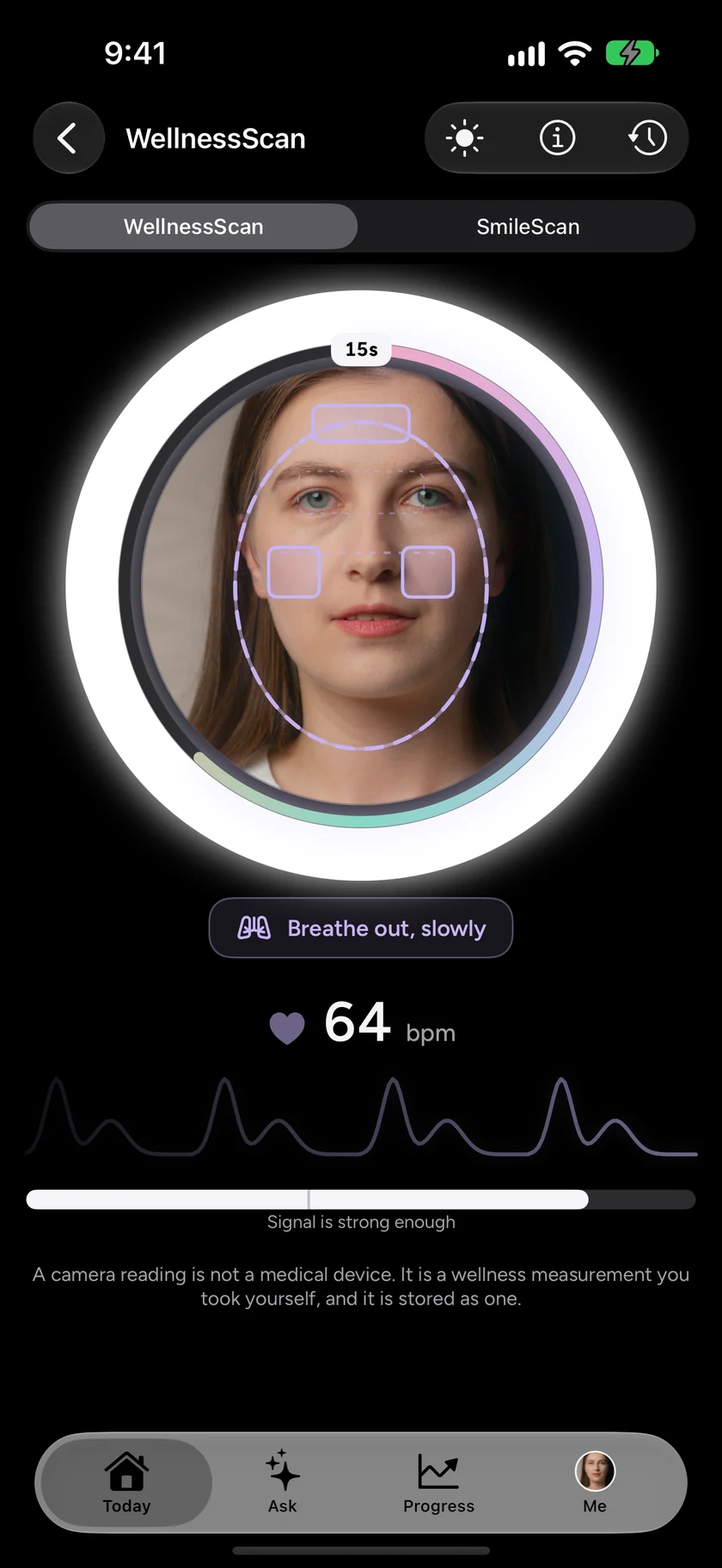
A camera reading thirty frames a second gives the scan about twelve hundred pictures of your face. From each one it takes three small patches of skin: your forehead, found from the landmarks of your eyebrows, and each cheek, found from your eyes and nose. Because the patches are anchored to your features rather than to fixed spots on the screen, they follow your face when it moves.
Why three? Because the heartbeat is the same in all of them and the noise is not. A shadow on one cheek, a strand of hair across the forehead, a bit of glare on the other cheek: each patch carries its own random errors. When you average the three, the pulse, which is shared, adds up, while the errors, which are not, partly cancel. In practice that roughly halves the noise any single patch would carry. It also means one bad patch cannot sink the reading on its own.
Researchers showed more than fifteen years ago that an ordinary camera in ordinary room light can pick up this pulse (Verkruysse, 2008).
Separating a pulse from a room
Lighting and movement change your skin’s color too, and by much more than your heart does. The useful trick is that they change it in a different way.
When you move your head or a cloud passes the window, all three color channels the camera records (red, green, blue) brighten or darken more or less together. A heartbeat does not do that. Blood absorbs green light far more strongly than red, so a pulse shifts the channels in its own particular proportion. The methods used in camera-pulse research exploit exactly that difference: combine the channels so the shared brightening cancels and the blood’s signature remains. The WellnessScan separates the pulse from the lighting and movement in the same way the research does, then keeps only the part that repeats at a believable heart rate.
This is also why the screen brightens when you start. Your phone becomes the light source, a steady, even one facing you, so the scan is not at the mercy of a flickering overhead light or a dim bedroom. More light on the skin means more of the tiny pulse signal compared with the camera’s own grain.
Why it asks you to breathe slowly
During the scan, a coach on screen paces your breathing: in for five, out for five, six breaths a minute.
Your heart rate naturally rises a little as you breathe in and falls as you breathe out. At a normal resting pace that swing is small and irregular. At six breaths a minute it becomes large, slow and regular, which does two things for a measurement. The breathing rate becomes easy to read, because the whole pulse trace sways at a pace the scan already expects. And the size of that swing becomes a reading in its own right: breath response, how far your heart rate rises and falls with each breath. A settled, recovered nervous system tends to swing more.
Pacing also makes every morning’s scan the same experiment. Breathing pattern moves heart-rate variability a great deal, so a scan where you happened to breathe fast and shallow is not comparable to one where you sighed slowly. Fix the breath, and the thing that changes from day to day is you.
Heart-rate variability, three ways
Once the scan has a clean pulse, it finds each beat and measures the gaps between them. Then it summarizes those gaps three ways, because each one asks a slightly different question.
- RMSSD looks only at neighbors: how much does each gap differ from the one right before it? It captures the fast, beat-to-beat changes driven by the calming side of your nervous system.
- SDNN looks at all the gaps together: how spread out are they over the whole recording? It includes the slower swings too, including the one your paced breathing creates.
- pNN50 is a count: what share of neighboring gaps differ by more than 50 milliseconds? It is coarser, and in a short recording it moves in steps, but it is easy to understand.
None of them is the right one. They are three views of the same rhythm, and what matters is comparing each with your own usual, which the scan does. HRV is also the most demanding thing it reports. At thirty frames a second, frames arrive 33 milliseconds apart, while the differences HRV cares about are often tens of milliseconds. Placing each beat that precisely takes a clean, still recording, so HRV is gated harder than anything else, and when the signal is not good enough the scan withholds the number rather than guess at it.
Tested, labeled and not kept
Every scan is stored with its signal quality, and you watch the signal meter fill as you scan. A poor reading is labeled as one, not quietly averaged into your trend. If you wear an Apple Watch, its heart rate from the same minute sits beside the result, which is the simplest honest check there is.
The scan also runs in a laptop browser, with the same history. That version is not a lookalike; it is the phone’s signal chain ported step for step and held to the same tests, so a reading at your desk means what a reading on your phone means.
No video is recorded and no image is kept. Each frame is measured and gone. What leaves the scan is numbers.
And the limit, stated plainly: a chest strap is far more precise than any camera. A strap reads the electrical signal of your heart, a sharp spike at each beat timed to the millisecond. A camera reads a softened wave of blood arriving at your face a fraction of a second later. The scan gives estimates, not clinical measurements. What it has going for it is that it needs nothing charged or worn, and asks the same question the same way every morning.
Wave Wellness is free on the App Store and Google Play. Download it and see your own WellnessScan today.
Wave is for general wellness and is not a medical device. A number from the scan is never a diagnosis; a heart that races, skips or pounds is a matter for your doctor.