If walking more is linked to living longer, walking a lot more should be linked to living a lot longer. Draw that line straight and a 30,000-step day makes you a decade younger. Do the same for a few more habits and, on paper, you stop aging.
Nobody believes that, yet plenty of longevity scores do the arithmetic anyway: every habit earns years, the years add up, and nothing stops the total. It looks precise, and it means very little once it leaves the range the evidence covers.
Evidence has edges
When Amanda Paluch and colleagues pooled fifteen cohorts of about 47,000 adults, the risk of dying fell as daily steps rose, and then it leveled off: at roughly 6,000 to 8,000 steps for people over 60, and 8,000 to 10,000 for younger adults (Paluch, 2022). Past that point, more steps did not buy measurably more.
Strength training looks similar. A 2022 meta-analysis linked muscle-strengthening work to about 10 to 20 percent lower risk of death, with the largest reduction at around 30 to 60 minutes a week; more than that did not keep improving the picture (Momma, 2022). Sleep is starker still: its risk curve is a U, rising under six hours and again over nine (Cappuccio, 2010).
There is a second edge, at the ends of every study. Cohorts are mostly ordinary people. Very few sleep four hours, walk 25,000 steps or have a resting heart rate of 40, so the estimates out there rest on a handful of people and wide uncertainty. A line drawn past the last data point is not a finding. It is a guess dressed as one.
Habits are not independent
The third problem is subtler. Resting heart rate, heart-rate variability, VO2 max and weekly cardio minutes are four different numbers, but they partly measure one thing: how fit your heart and lungs are. A study that found a hazard ratio for one of them was, to some degree, picking up the others too.
Stack all four as if they were separate and you count the same fitness several times. A fit person gets credit for being fit, then for the low heart rate that comes with it, then for the high HRV, then for the training behind all three. Each step is defensible on its own. The sum is not.
So an honest lifestyle age needs two kinds of limit: a cap on what any one input can be worth, and a cap on the total.
How Wave Age is bounded
Wave Age in Wave Wellness turns lifestyle into years by one stated rule. In adults, the risk of dying roughly doubles with every eight years of age, a regularity described in the 1820s (Gompertz, 1825) and observed ever since. So a hazard ratio is worth 8 × log2(HR) years: a ratio of 2 is eight years older, a ratio of 0.5 is eight years younger.
The ratios come from named studies: resting heart rate (Jensen, 2013), VO2 max (Kodama, 2009), steps against a 7,500 reference (Paluch, 2022), sleep under six or over nine hours (Cappuccio, 2010), strength training once or twice a week (Momma, 2022) and fiber at 25 to 29 grams a day (Reynolds, 2019), plus HRV, cardio minutes, BMI, protein and breathing rate. They are read from Apple Health, the WellnessScan, your training and your food log.
Every weight is capped, so no single habit can run away with the number, and the “What moves it” list adds up to the total, so you see each input’s share in years.
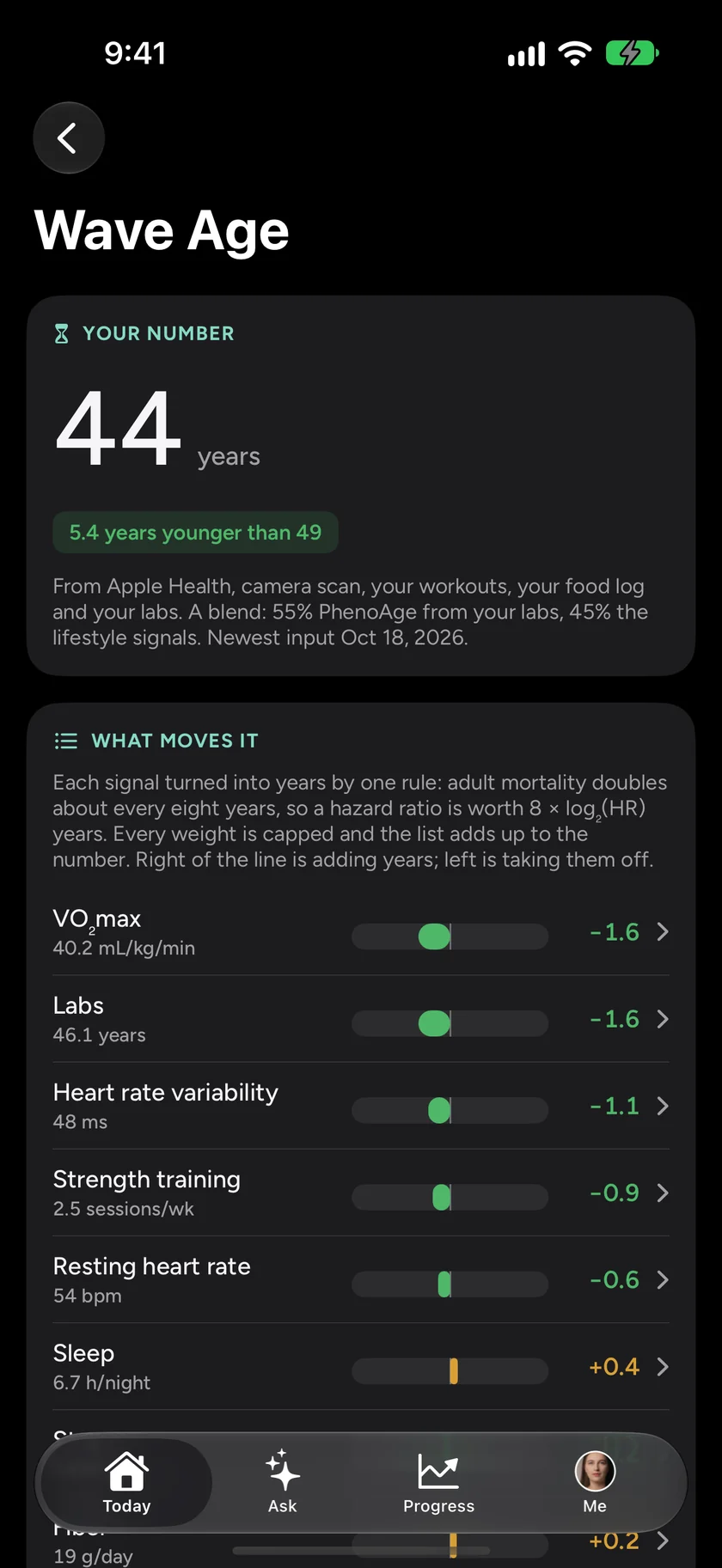
Then the whole number is held between 10 years younger and 12 years older than your real age.
Run those limits back through the same rule. Ten years younger is a hazard ratio of about 0.42: the claim that your risk of dying is well under half that of people your age. Twelve years older is about 2.8 times. Those are already large claims to make from a watch, a camera and a food log. Past them, extra years would mostly come from adding up overlapping effects, not from anything measured.
The bounds are not symmetric. The range runs two years further on the older side, so the number has more room to tell you about a problem than to flatter you.
The lab half follows the same instinct. PhenoAge (Levine, 2018) needs all nine of its markers from a routine lab sheet, and Wave names a missing marker rather than filling it with an average: nine markers or no number. When labs and lifestyle both exist, they are blended 55 to 45, labs first.
What a cap costs
A ceiling has a price. If you really are exceptional, a lifelong endurance athlete with superb labs, the cap may undersell you. That is the trade: a number that occasionally undersells a rare person is more useful to everyone else than one that routinely oversells ordinary habits.
A cap does not make the number right, either. Inside its bounds, Wave Age is still a population model applied to your numbers, not a diagnosis and not a prognosis. Its value is in the direction it moves and in which line moved it, not in the decimal.
What the bounds buy is a number that stays inside what it can defend. So the next time a longevity score tells you that you are twenty years younger, do not ask how it got so high. Ask what was supposed to stop it.
Wave Wellness is free on the App Store and Google Play. Download it and see your own Wave Age, and what moves it today.
Wave is for general wellness and is not a medical device. It does not diagnose or treat anything; talk to a doctor about your labs, your heart rate or any change in your health.