Take two people, both 5 foot 10 and 200 pounds. One lifts four days a week and runs on weekends. The other has not exercised in years. On a body mass index chart they are the same person: 28.7, overweight, and the chart tells both of them so with exactly the same confidence.
The number is not wrong, exactly. It is answering a question it was never built to answer.
A statistic for crowds
The formula is almost two hundred years old. In the 1830s the Belgian statistician Adolphe Quetelet, who was trying to describe the “average man” of a population, noticed that adult weight tends to rise with the square of height. Weight in kilograms divided by height in meters squared was, for him, a way to describe a group, not a verdict on anyone in it.
It got its modern name in 1972, when Ancel Keys and colleagues compared several weight-for-height formulas against measured body fat. This one did best, and they called it the body mass index (Keys, 1972). Its strength was comparing populations.
It stuck because it is cheap. Two numbers every clinic already records, one line of arithmetic, and the familiar bands (under 18.5, 18.5 to 25, 25 to 30, 30 and over) hand out a label on the spot.
What it cannot see
The arithmetic has a blind spot built in: weight is weight. A pound of muscle, fat, bone or water all count the same. So BMI cannot tell a muscular body from a heavy one, and it cannot see where fat sits, even though fat around the waist and organs is the kind most closely tied to heart and metabolic risk.
The error runs both ways. A review of studies that compared BMI with direct measures of body fat found that the usual cutoff of 30 missed about half of the people who had excess body fat, while rarely flagging someone who did not (Okorodudu, 2010). A “normal” BMI can hide plenty of fat on a frame with little muscle; an “overweight” one can belong to someone who is mostly muscle. In 2023 the American Medical Association adopted a policy calling BMI an imperfect measure and urging doctors to use it alongside other measures rather than alone.
None of that makes it meaningless. Across very large groups it does track risk: a meta-analysis covering millions of people found the lowest mortality with a BMI in the low to mid twenties, rising steadily above that (Aune, 2016). The trouble is only ever using it alone, as though it knew more about one particular body than it does.
How Wave Age reads it
Wave Age in Wave Wellness turns your measurements into one biological age, and under the number sits a list called “What moves it”: every signal, and the years it adds or removes. BMI is one line on that list, calculated from your newest weight and your height, and it is read with three limits.
It can only add. A BMI from 18.5 to 25 contributes nothing. Being in range earns no years off, because a normal BMI says too little on its own to deserve credit. Above 25 it adds years gradually, following the rise in risk in the research it cites. Below 18.5 it adds them too, since being underweight carries its own risk.
It is capped. Every signal turns a hazard ratio into years with one rule, 8 × log2 of the ratio, because adult mortality roughly doubles every eight years. Every signal also has a ceiling. BMI’s is three years. VO2 max, a far richer measure of what your body can do, can move the number by up to five in either direction.
It never stands alone. The same list reads resting heart rate and heart rate variability from Apple Health or the WellnessScan, plus VO2 max, steps, sleep, cardio minutes and strength sessions from your training, and fiber and protein from your food log. Once lab results are in, an age built from nine blood markers makes up 55% of the blend, BMI is not one of them, and every lifestyle line, BMI included, shrinks to its share.
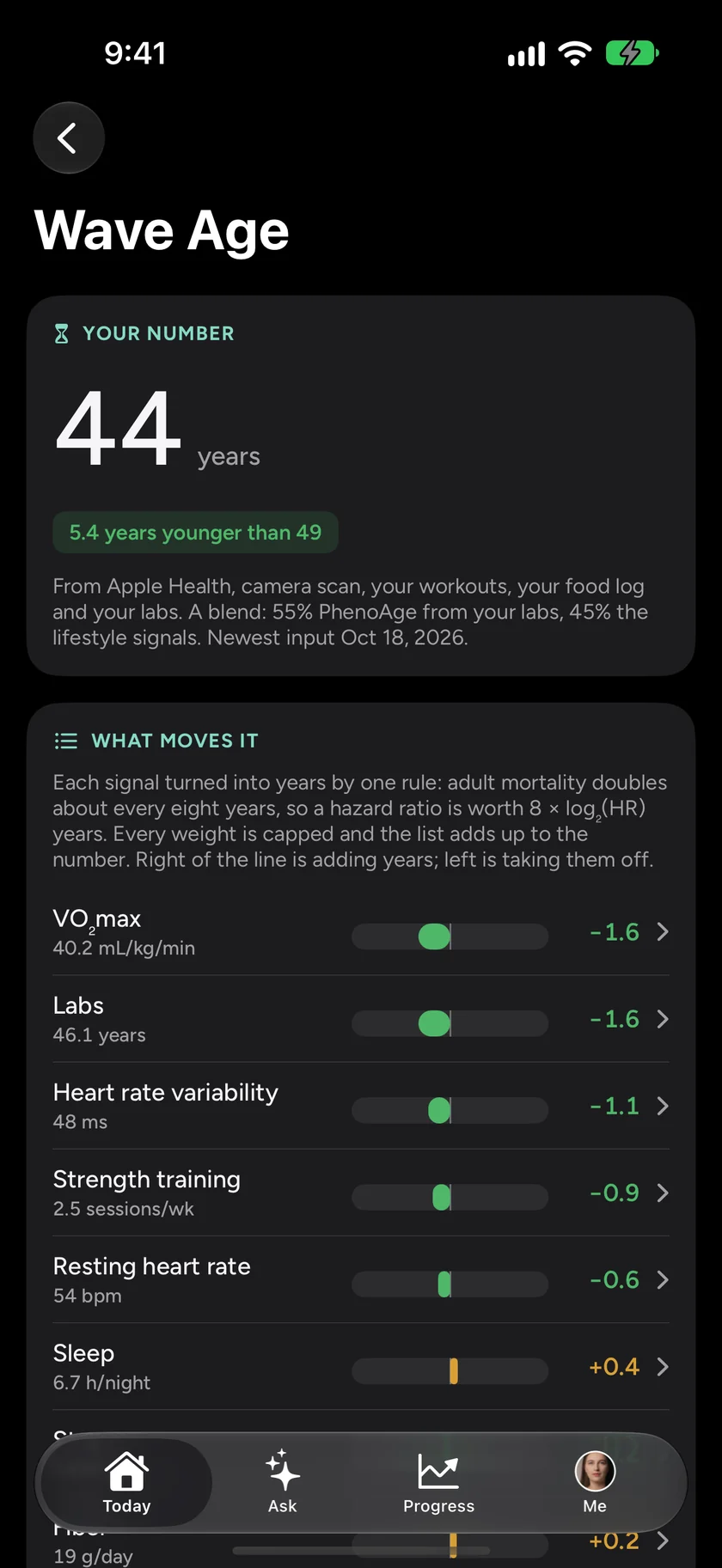
Back to the two people at 28.7. Before any labs, Wave Age reads that BMI as about two years older for each of them. For the one who lifts and runs, those two years sit beside a strong VO2 max, regular strength training and a low resting heart rate, each taking years off, and the list shows exactly how they net out. For the other, the BMI line has company pointing the same way. Same number, different context, and the context is on the screen rather than buried in a label.
What it still misses
Wave cannot see body fat either. It reads the weight you log and the height in your profile, nothing more, so your two hundred pounds look like anyone else’s. What it can do is keep that limit in proportion: let a blunt number count for a little, never for a lot, and set it beside measures of what your body actually does.
A tape measure helps if you want a second view. Waist size says something about where fat sits that weight alone cannot, and it costs nothing.
The idea works without any app. The next time a single number claims to sum up your health, ask what it was built to measure and what it leaves out. BMI was built to describe crowds. You are not one.
Wave Wellness is free on the App Store and Google Play. Download it and see your own Wave Age today.
Wave is for general wellness and is not a medical device. It does not diagnose or treat anything; talk to a doctor about your weight and what a healthy range looks like for you.