Most sleep audio is designed for the first twenty minutes and then left running for the next seven hours. The rain track loops until morning. The playlist rolls into the next playlist. The podcast you fell asleep to finishes, and the app helpfully starts another one.
That is a design flaw, and it comes from a simple misunderstanding about what sound is for at night. Sound helps you get to sleep. Once you are there, it has done its job, and every minute after that it is asking something of a brain that has better things to do.
Your ears do not go to bed
Sleep is not a switch that disconnects you from the world. The auditory system keeps working all night: sound still reaches the brain, and the brain keeps deciding whether it matters. That is why a parent wakes to a baby’s whimper and sleeps through traffic, and why your own name spoken quietly can rouse you when louder, meaningless noise does not.
The sorting has a cost. Research on night-time noise has shown for decades that sound can produce brief arousals, a lightening of sleep or a bump in heart rate, without waking you enough to remember it. You do not experience these as interruptions. You experience them, if at all, as a morning that feels less rested than the hours suggest.
What the brain reacts to most is change. A steady, featureless sound fades into the background; a shift in volume, a new instrument, a voice, a track ending and another beginning, is exactly the kind of thing a sleeping brain is built to check. An all-night loop is full of small changes. Every seam in it is a question your brain has to answer.
What the evidence supports
The research on sound as a sleep aid is more modest than the app stores suggest. Studies of continuous white or pink noise through the night are mixed and mostly small, and reviews have generally found the evidence weak. Music has a better case, mainly for helping people relax and fall asleep, and the typical study tests listening at bedtime for something like half an hour, not a soundtrack for the whole night.
So the defensible version of a sleep sound looks like this: something calm to settle you, for long enough to cover falling asleep, and then out of the way.
The last part is the one most apps skip, and it is harder than it looks. Stopping is itself a change. A track that cuts off mid-phrase in a quiet room is precisely the kind of event that can pull a lightly sleeping brain back up. The ending has to be designed.
How Wave Wellness builds it
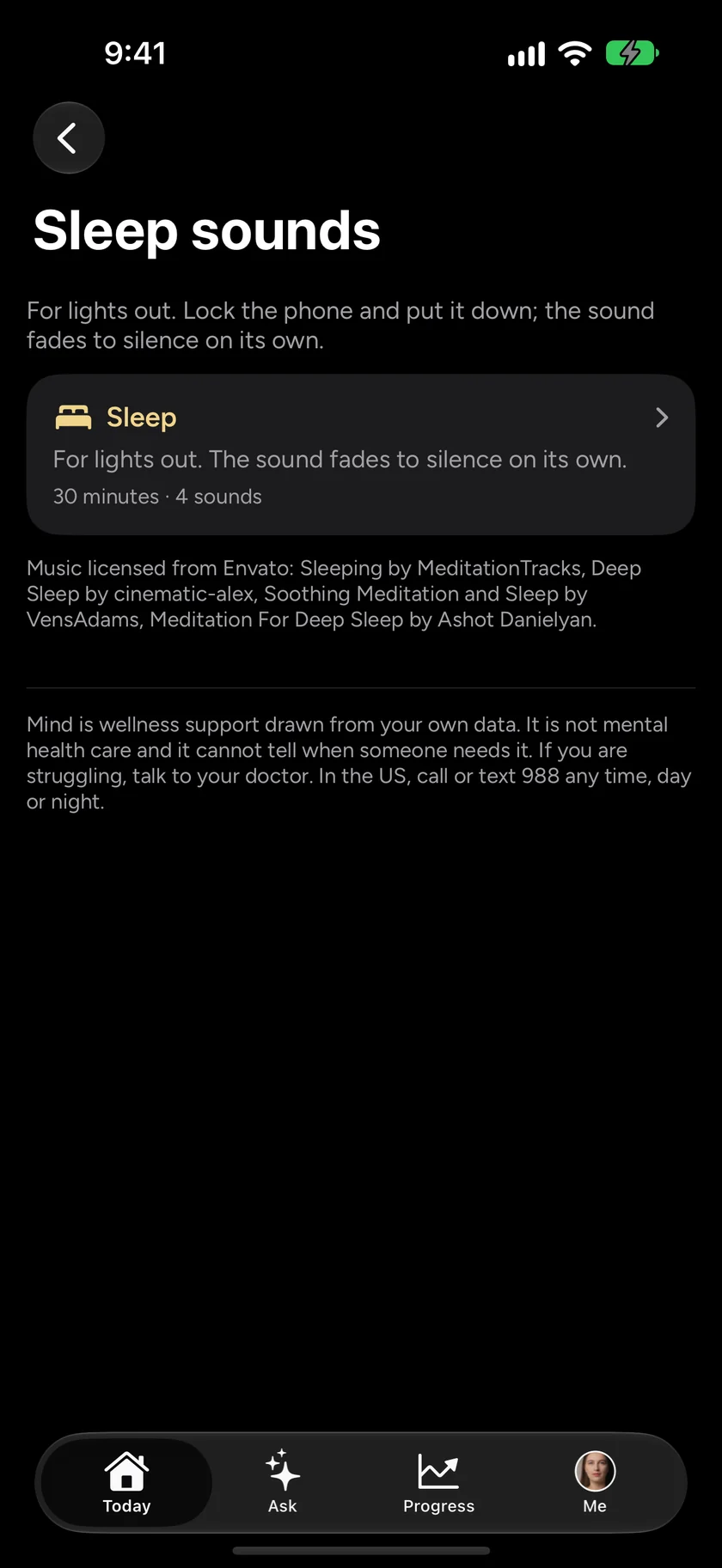
Wave’s Sleep sounds are built around the ending. You choose 30, 45 or 60 minutes, lock the phone and put it down. Over the last five minutes the sound fades to silence on its own: no click, no final note, no next track.
The other decisions follow from the same idea.
Wordless. There are no voices and no lyrics. Language is the hardest thing for a brain to ignore; it reaches for meaning automatically, awake or nearly asleep. A sentence is a small task. A melody without words is not.
Licensed. The music is licensed from working composers, and they are credited on the screen. It is real music made to be listened to, not a generated loop.
No breathing cue. This one surprises people, because Wave is full of paced breathing. The WellnessScan coaches six breaths a minute; Wave Reset pairs sound with slow breathing and a breathing light, and has a Sleep mode of its own. But a breathing cue is an instruction, and following an instruction is a task. You have to listen for it, match it, notice when you drift off the pace. That is useful when you are winding down and want something to hold your attention. It is the opposite of what you want at the moment of falling asleep, which is mostly a matter of letting go of control, including control of your breath.
So the two are kept apart. Breathe with Reset while you are still awake, if it helps you settle. When the light goes out, the sound asks nothing of you at all.
What it is not
A sleep sound is a comfort, not a cure. If it helps you drift off faster, good. If you sleep perfectly well in silence, you do not need it, and silence is a fine thing to sleep in.
It is also not a treatment for real insomnia. Trouble falling or staying asleep that lasts for weeks deserves a proper look, and the best-supported treatment for chronic insomnia is a structured program, cognitive behavioral therapy for insomnia, not a soundtrack.
And timing still matters more than any audio. A regular bedtime, morning daylight, and the last coffee and the last drink kept well away from bed will do more for most nights than the best rain track ever recorded.
What a sleep sound can do is help you across the line between awake and asleep, and then leave you alone. The kindest thing a sound can do at night is end.
Wave Wellness is free on the App Store and Google Play. Download it and see your own sleep today.
Wave is for general wellness and is not a medical device. It does not diagnose or treat sleep disorders; if poor sleep lasts more than a few weeks, talk to a doctor.