Plot sleep against risk and you do not get a line. You get a U. In 2010, Francesco Cappuccio and colleagues pooled prospective studies covering more than a million people and found that short sleepers were about 12 percent more likely to die over the follow-up than people sleeping a middling amount, and long sleepers about 30 percent more likely (Cappuccio, 2010).
The second number surprises almost everyone. The people at the long end fared worse than the people at the short end. More sleep is not simply better sleep. Somewhere in the middle there is a floor, and the useful question is not “how much can I get” but “where is the floor, and how do I stay on it”.
Two sides, two different stories
The two arms of the U do not mean the same thing, and treating them alike is the most common mistake people make with this research.
The short side has causal evidence behind it, not just association. In a well-known experiment, people restricted to six hours a night for two weeks slid steadily on attention and reaction tests, until their scores looked like those of people who had missed one or two full nights of sleep. Their own sense of sleepiness rose only a little (Van Dongen, 2003). They were getting worse, and they did not feel it. That is why short sleep is easy to live with and hard to notice: the instrument you would use to detect it is the one it dulls.
The long side is murkier. Most researchers read it largely as a marker rather than a cause. Illness, low mood, inactivity and poor-quality sleep all push time in bed up, and those things carry their own risk. There is no good evidence that a healthy person who sleeps nine and a half hours would live longer by setting an alarm. So the long arm of the U is less a warning about sleeping in on Saturday and more a flag: if you routinely need ten hours and still wake tired, that is worth asking about.
Between the two arms the curve runs fairly flat. Different studies draw the edges a little differently, but the expert consensus lands in the same place: adults should regularly sleep seven or more hours a night (Watson, 2015). Seven is the floor. The flat bottom runs from there to somewhere around nine.
Why aim for 7.5 and not 7
If seven is the floor, why set the goal half an hour above it?
Because a goal is an aim, and nobody hits their aim every night. Some nights you fall asleep late, wake at three or get up early for a flight. If you aim at exactly seven, your ordinary misses land below the floor, on the steep side of the curve. Aim at seven and a half and the same misses mostly land at seven or just under, still near the flat part.
There is a second gap. Time in bed is not time asleep. Everyone loses some of the night to falling asleep and to brief wakings they never remember. Aiming a little high is how you leave room for that without counting on a perfect night.
And it stays well clear of the other end: seven and a half sits roughly in the middle of the flat bottom.
How Wave reads your nights
Wave Wellness sets a default sleep goal of 7.5 hours, and the Sleep page draws the last two weeks against it as a dashed line, with a plain sentence about the week underneath.
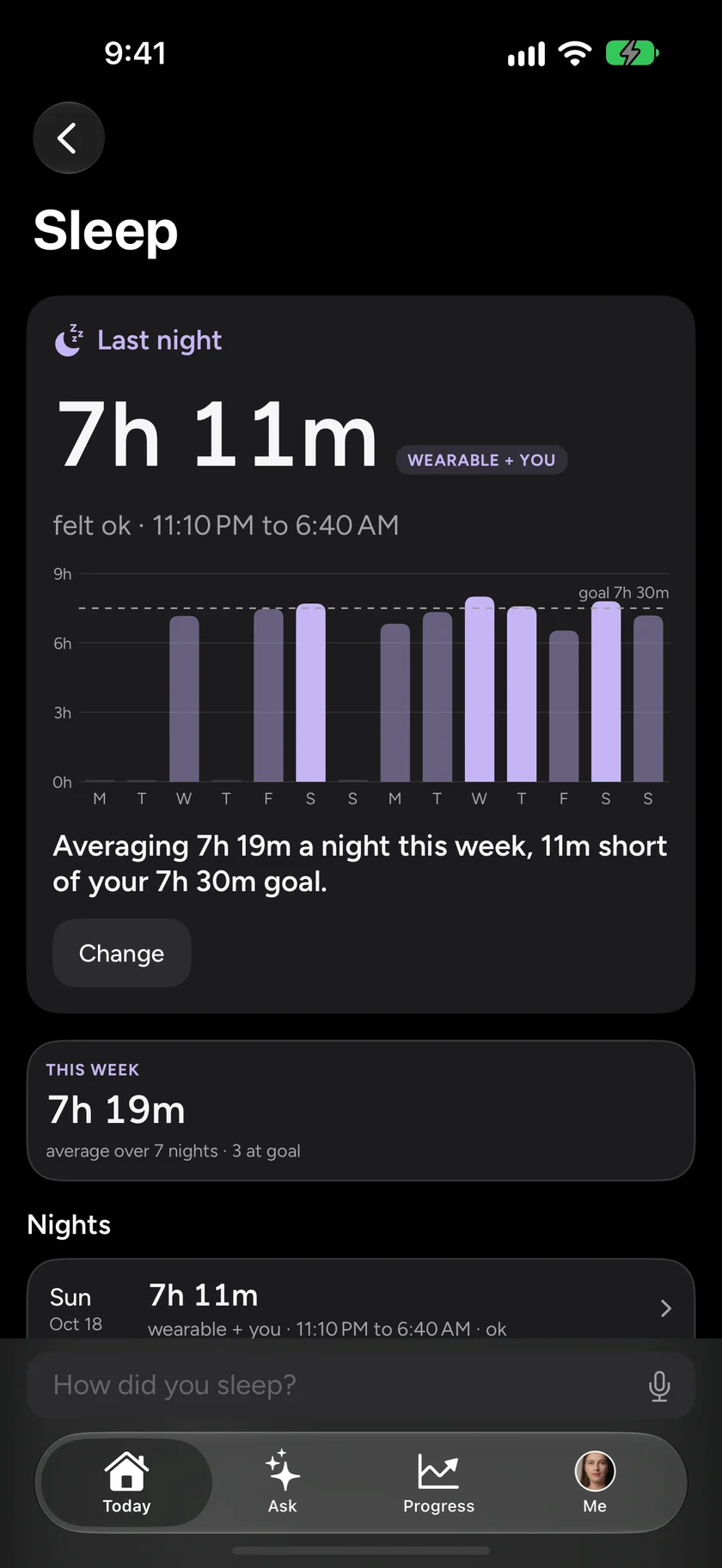
The U shows up in two other places, each doing a different job.
Today’s Wave, the daily score, gives sleep up to 20 points either way. Half of that is measured against your own usual, so a short night counts against you even if you are normally a long sleeper. The other half is measured against seven hours, the floor, so someone who habitually sleeps six does not get full credit just for being consistent. That is the consensus line, built into the arithmetic.
Wave Age, the biological age, uses the U itself. Sleep under six hours or over nine counts against you, citing the same Cappuccio meta-analysis, and “What moves it” shows the years it adds or removes. Anywhere between six and nine, it adds nothing.
The nights come from wherever you have them: duration and stages from a watch, ring or strap through Apple Health or WHOOP, and how it felt and when you went to bed from you, labeled separately. With no wearable, you can log the night yourself.
A default, not a rule
Seven and a half is a starting point, not a verdict on your life. If a new baby or a night shift means it is out of reach for now, change it. Setting a goal of seven and meeting it beats failing seven and a half every night, and the readings stay either way.
Two honest limits. A night’s length is one number; it says nothing about how regular your bedtimes are, which matters too. And the research is about populations. The bottom of the curve is wide on purpose, because people differ. The point is not to hit 7.5 to the minute. It is to stop drifting off either edge without noticing.
Wave Wellness is free on the App Store and Google Play. Download it and see your own nights against the curve today.
Wave is for general wellness and is not a medical device. It does not diagnose or treat anything; talk to a doctor if you regularly sleep more than nine hours and still wake tired, or if you snore heavily or stop breathing in your sleep.