Almost every piece of advice about calming down asks you to take it on faith. Try this app, this playlist, this bath, this stretch, and you will feel better. Maybe you do. But “feel better” is a slippery thing to judge from the inside, especially when you are stressed, and the advice rarely offers a way to check.
Breathing slowly is different. It is one of the few things you can do to calm your body whose effect shows up in a number, often within minutes, and the number is your own heart.
Your heart already follows your breath
Put two fingers on your pulse and breathe in slowly. If you pay attention, your heart rate picks up a little. Breathe out slowly and it eases off. This is normal, healthy and has a name, respiratory sinus arrhythmia, which sounds like a problem and is the opposite: it is the calming side of your nervous system working the brake on your heart in time with your breath. Release the brake on the in-breath, apply it on the out-breath.
There is a second rhythm running underneath. Your body constantly adjusts blood pressure through a reflex loop, and that loop has a natural cycle of roughly ten seconds. Normally your breath and that loop run at different speeds and partly get in each other’s way.
Slow your breathing to around six breaths a minute, one breath every ten seconds, and the two rhythms line up. They push in the same direction at the same time, and the rise and fall of your heart rate with each breath grows much larger and smoother. Researchers call this resonance breathing, and it has been studied for decades as a way to train heart-rate variability (Lehrer and Gevirtz, 2014). The exact best pace varies a little from person to person, but six a minute sits close to it for most adults, which is why it is the pace so many breathing practices land on.
Two things follow from it, stated carefully. In the moment, slow breathing tends to lower heart rate and shift the nervous system toward rest. And with regular practice, studies of slow-breathing training have found resting HRV can move in the right direction. It is not a cure for anything. It is a lever you can pull yourself, with no equipment, that your body actually responds to.
The missing part is the before and after
Here is the problem with even good advice: you do not know how well it works for you. People differ. One person settles fastest lying down in the dark with long tones; another needs something to focus on; another finds silence harder than noise. Studies average all of those people together. You are not an average.
What you want is the experiment run on yourself. Measure, do the thing, measure again, the same way each time. Repeat it enough times that one odd day does not fool you. Then look at which version actually moved your numbers.
That is the whole design of Wave Reset in Wave Wellness.
How Wave Reset works
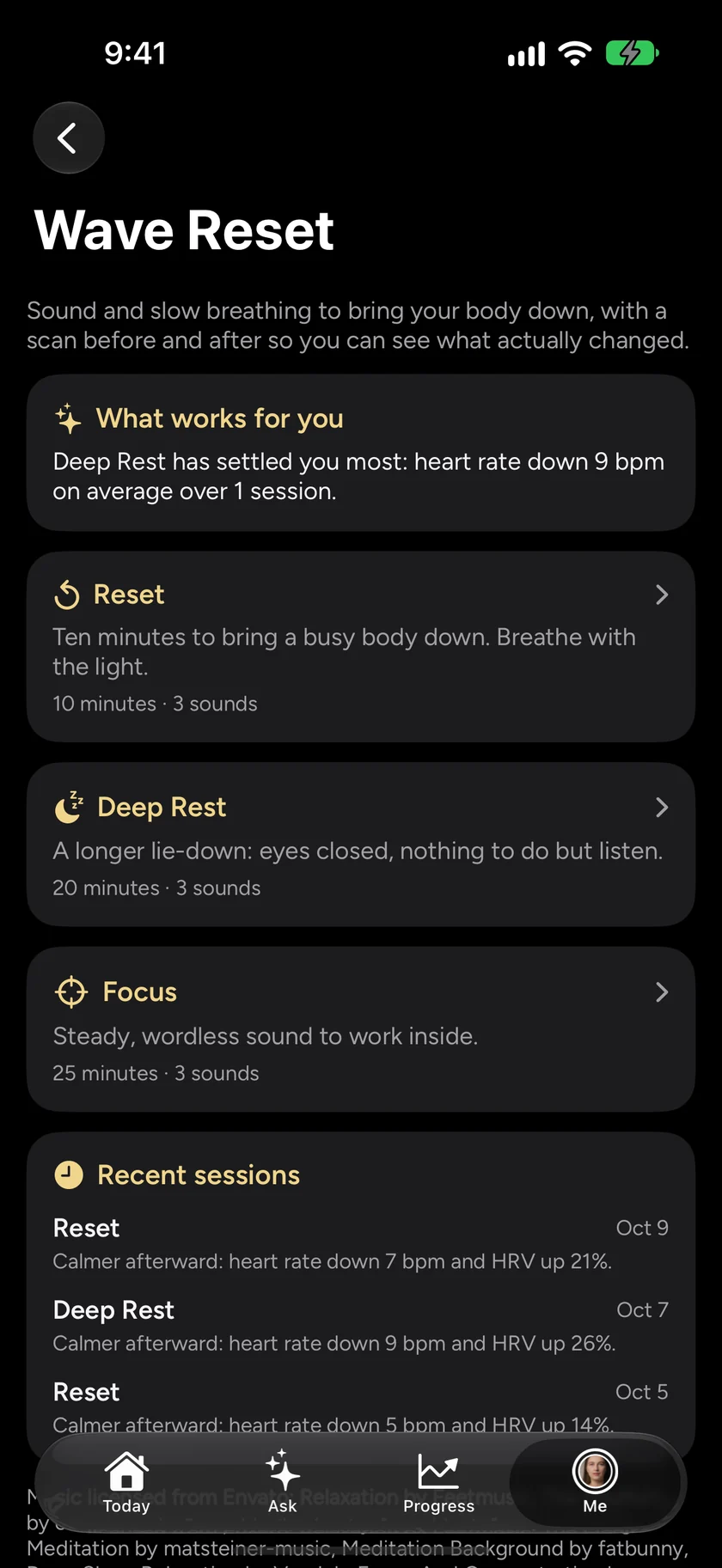
Wave Reset is sound plus slow breathing, at six breaths a minute. A breathing light paces you, and an optional haptic tap lets you follow it with your eyes closed. The music is licensed and wordless. There are four modes: Reset (ten minutes, to bring a busy body down), Deep Rest (a longer lie-down where you just listen), Sleep and Focus.
The part that makes it different is on either side of the session. Before you start, a thirty-second scan with your phone’s camera reads your heart rate, HRV and breathing. When you finish, it reads them again. Then it shows you what changed: heart rate down by this many beats, HRV up by this much, breathing slower or not.
After a few sessions, a card called “What works for you” names the mode that has settled you most, and your average drop in heart rate with it. It is not a recommendation from a study. It is a summary of your own sessions.
If you just want two minutes, the Relax area has a shorter version: “Start two minutes” of paced breathing at six a minute, with a scan after.
Reading your own results honestly
A before and after is powerful, and it is worth knowing what it can and cannot prove.
Some of any drop in heart rate comes simply from sitting or lying still for ten minutes, whatever you are listening to. That is fine, because it is the same for every mode, so comparing modes against each other still tells you something real. It is also why “What works for you” waits for a few sessions rather than crowning a winner after one.
HRV deserves a second caution. Slow breathing makes the swings between beats bigger almost by definition, and bigger swings are exactly what HRV counts. So an HRV reading taken while you are still breathing slowly will tend to look good. Heart rate is the plainer signal, which is why the card reports your average drop in heart rate.
And thirty seconds from a camera is an estimate, not a lab measurement. A single session’s numbers can wobble. A pattern over several sessions is the thing to trust.
Calm is measurable
The point is not that a number should replace how you feel. It is that the two together are better than either alone. Some days you will finish a session feeling no different and the scan will show your heart rate dropped by several beats; your body settled before your mind caught up. Other days you will feel calmer and the numbers will barely move, which is worth knowing too.
Over a few weeks, you end up with something most relaxation advice never gives you: evidence. Not that breathing works for people in general, but which way of doing it works for you, measured on your own heart.
Wave Wellness is free on the App Store and Google Play. Download it and see how your own calm moves today.
Wave is for general wellness and is not a medical device. It does not diagnose or treat anything; talk to a doctor about anxiety, panic, or a heart rhythm that worries you.