Ask someone how they are and you get one word: fine, rough, good, tired. Notice that “tired” is not the opposite of “good”. Plenty of people are tired and perfectly happy, curled up at the end of a long day that went well. Plenty of others are wide awake and having an awful time, heart going, mind racing, nowhere near sleep.
That one word is answering two questions at once. Psychologists have treated them as separate for more than forty years.
Two axes, not one line
In 1980 the psychologist James Russell proposed what he called a circumplex model of affect (Russell, 1980). Instead of lining feelings up from bad to good, he placed them on two axes. One runs from unpleasant to pleasant. The other runs from low activation to high. Calm, content, sleepy, alert, tense, excited and miserable each land somewhere on that flat map, and the useful part is that the two directions move independently.
Other researchers arrived at a similar shape. Robert Thayer spent years separating what he called energetic arousal (feeling vigorous and awake) from tense arousal (feeling keyed up and anxious), and argued that how you feel at any moment is largely the mix of the two (Thayer, 1989). The Positive and Negative Affect Schedule, one of the most widely used questionnaires in the field, was built on the finding that positive and negative feelings are not simply two ends of one scale (Watson, 1988).
You can see it in your own week as four quite different mornings that a single question would score the same.
Four mornings that look alike on one scale
- Good and firing. Slept well, feel bright, want to do things. No notes.
- Good but drained. Nothing is wrong, you are just low on fuel. A big day yesterday, a short night, a cold coming on.
- Rough but wired. Plenty of energy, all of it the wrong kind. A deadline, an argument, a third coffee.
- Rough and drained. Flat on both counts. The morning that most needs a gentle plan.
Ask “how are you, 1 to 5?” and the middle two might both come out as a 3. They need opposite things. The drained-but-fine morning wants rest, food and maybe an easier session. The wired-but-rough one is the last morning to add caffeine and intervals; it is better served by something that brings the activation down, like a walk outside or a few minutes of slow breathing.
Thayer tested a small version of this. In one study, a brisk ten-minute walk raised people’s self-rated energy more than a sugary snack did, and the snack left them more tense an hour later (Thayer, 1987). The point is not the candy. It is that energy and tension can be pushed separately, by different things, and you can only tell which one moved if you were asking about each.
Why separate answers make better data
There is a measurement reason too. A single “how do you feel” answer has to average two things that often disagree, and an average of two disagreeing numbers hides both. Over a few weeks, the patterns that matter are usually in one axis, not the blend: energy that sags every Thursday, mood that dips after short nights while energy holds up, energy that rises on days you moved even when mood does not.
Those are the patterns you can act on. A sag in energy points toward sleep, food and training load. A run of low mood with normal energy is a different conversation, and one worth noticing early.
How Wave asks
The check-in in Wave Wellness is five one-tap questions, about ten seconds. The first two are the two axes. “How do you feel today?” runs from Rough to Great. “How is your energy?” runs from Drained to Firing. Sleep, food and movement follow, and a note if you want one.
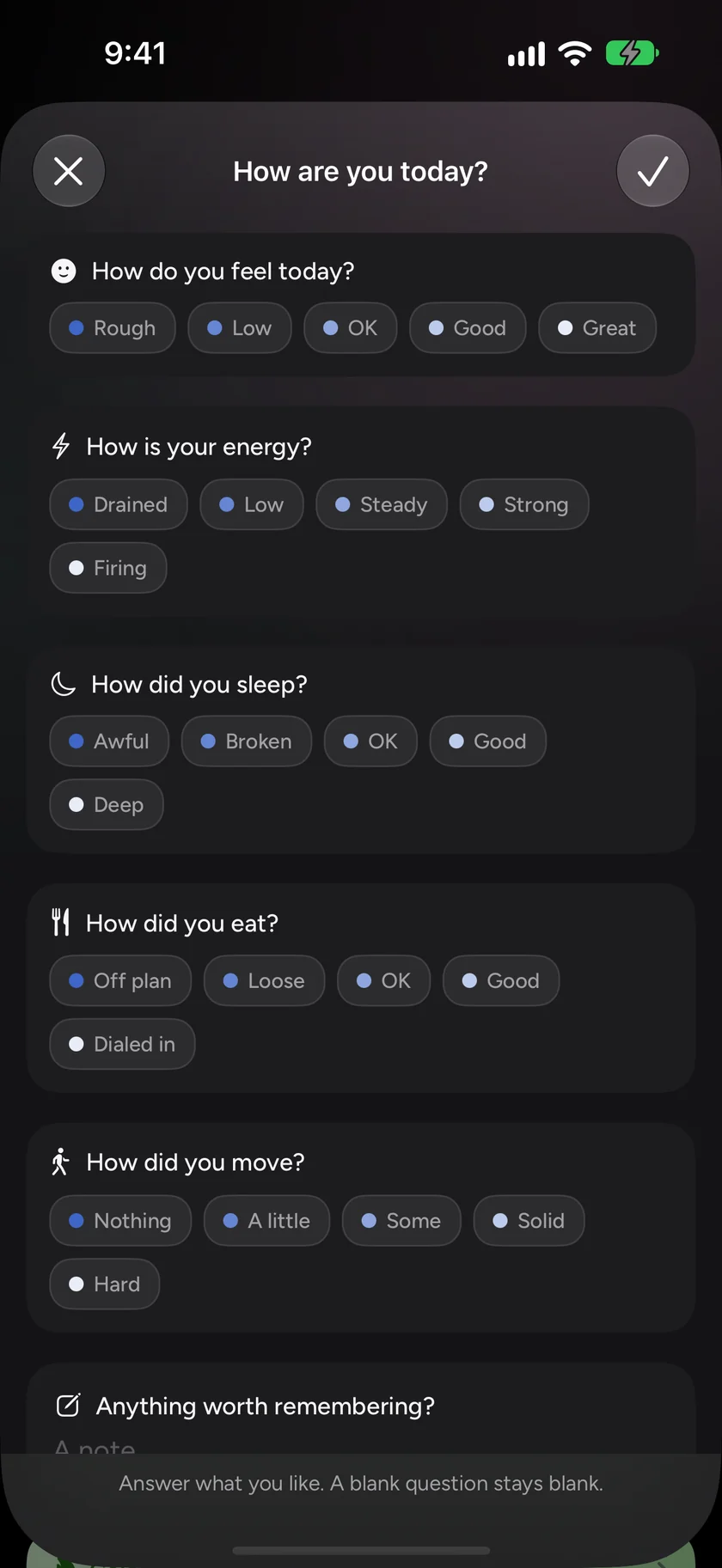
A few design choices follow from treating them as two measurements:
Five is always better. Both scales run 1 to 5 with 5 at the good end, so “Firing” and “Great” read the same direction. The colors are a blue ramp, not red and green, so a low answer looks like information rather than a warning.
A blank question stays blank. If you answer mood and skip energy, energy is stored as nothing, not quietly filled in with a 3. A made-up middle answer would flatten exactly the difference the two questions exist to catch.
They count, within limits. Mood and energy feed Today’s Wave, the daily score, worth up to 15 points either way beside HRV, resting heart rate, sleep and yesterday’s training. The score is plain arithmetic with no AI in it, so that contribution is exactly what it says. Enough that a flat morning registers when your heart rate looks fine; not enough for one bad hour to outvote a body that is clearly recovered.
They sit side by side. Relax shows mood, energy and sleep together over fourteen days, which is where the two axes earn their keep. Two weeks of steady mood and sinking energy reads very differently from the reverse.
What it cannot tell you
Two questions are still a rough instrument. Your answers drift with the hour you check in, so pick a time and keep it. Your 3 is not anyone else’s 3, which is fine as long as you compare yourself with yourself. And a check-in records how you say you feel. It does not know why, and it does not try to guess. When a pattern shows up, the useful next step is usually a question you ask yourself, or Wave Reset on a wired morning to see whether a few minutes of slow breathing settles your heart rate.
The habit works without any app. Tomorrow morning, ask yourself both questions, how you feel and how much energy you have, and answer them separately. You may find the second one tells you more about the day ahead.
Wave Wellness is free on the App Store and Google Play. Download it and see your own check-ins today.
Wave is for general wellness and is not a medical device. It does not diagnose or treat anything; if low mood or exhaustion lasts more than a couple of weeks, talk to a doctor.