Put your morning score where friends can see it and something shifts within a week or two. Nobody says it, but everyone checks where they landed against everyone else. A 62 that would have been an ordinary Tuesday becomes the lowest number in the group.
That is not a flaw in your friends. It is how people work, and it is worth designing around.
We measure ourselves against whoever is nearby
In 1954 the psychologist Leon Festinger proposed that when people have no objective yardstick for how they are doing, they use other people (Festinger, 1954). The research on social comparison since then has mostly confirmed the instinct and added a catch: the comparison is rarely neutral. Look up at someone doing better and you can come away feeling worse. Look down and you may feel better, but you have learned nothing you can use.
Health numbers are perfect fuel for this, because they look like a ranking and are nothing of the kind. Resting heart rate depends partly on age and genes. HRV varies widely between perfectly healthy people. Sleep depends on whether there is a newborn in the house. Set two people’s numbers side by side and the gap mostly measures how different they are, not how hard they are trying. Still, a number next to a number reads as a scoreboard.
There is a second cost. Body data are private in a way a step count pretends not to be. A slipping sleep line can mean a hard month at home. A friend does not need to know that to encourage you.
What friends are actually good for
Friends help in a different way: by noticing that you showed up. Keeping a habit is mostly repetition, and repetition is dull. A friend who sees you have checked in nine days running, and says so, makes the tenth day a little more likely. What they noticed is the one thing fully in your control.
That suggests a simple rule: share the effort, keep the outcomes. Effort is something anyone can match, whatever their age, genes or week. Outcomes belong to your body and your life, and setting them against someone else’s mostly produces the feelings Festinger described.
How the circle works
The circle in Wave Wellness is a private group of friends built on that rule. They see two things: your check-in streak and your milestones. They do not see your scores, your sleep or your labs. Not Today’s Wave, not Wave Age, not a single reading.
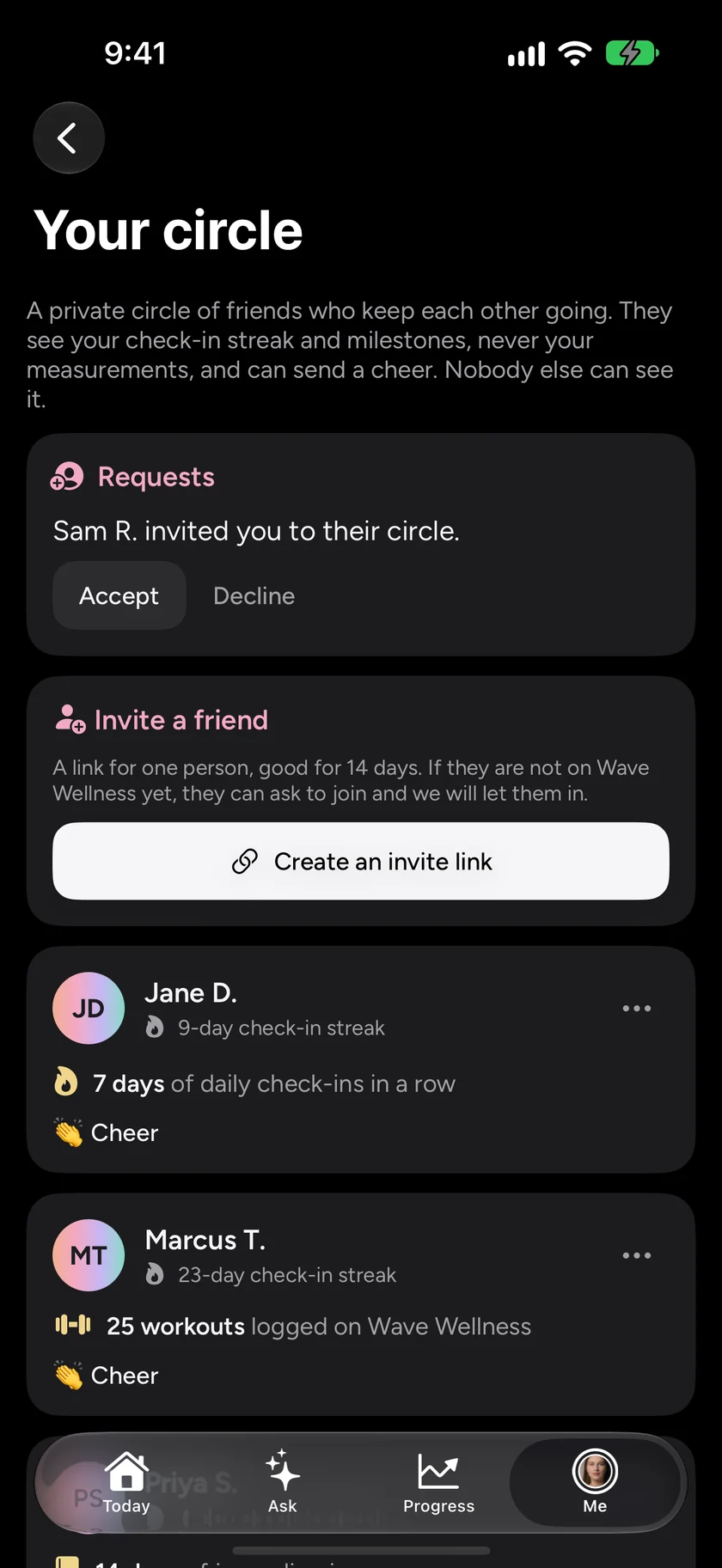
The check-in is the right thing to share because it measures only showing up. Five taps, about ten seconds, on any kind of day. A streak says you kept paying attention, not that you were well.
Milestones follow the same logic: seven check-ins in a row, ten workouts, a goal reached, two weeks of journaling. Each one counts doing something, never how well it went. The journaling milestone counts that you wrote; the entries themselves are never shown to anyone, the Wave Wellness team included.
What friends can do with all this is small on purpose. They can send a Cheer. There is no leaderboard, no ranking and no comment feed to keep up with.
Getting in is deliberate too. An invite is a link for one person, good for 14 days, so it cannot be posted to a crowd and quietly collect strangers for months. Your circle is the people you chose, and nobody else can see it.
When you do want to share a milestone more widely, the card is drawn on your phone and you share it wherever you like. Nothing is uploaded to make it.
Where it falls short
This design gives some things up. Some people genuinely thrive on competition, and for them a leaderboard is fuel, not pressure. The circle will not give them one.
A streak has a known failure mode too: once it gets long, breaking it can feel like losing everything, and people sometimes stop after a miss rather than start again. A streak is a nudge, not a measure of worth. One missed day is one missed day.
And a Cheer is not support in the deeper sense. When a friend’s streak stops, you can see that they have gone quiet. You cannot see why, and the app is built so that you should not. If it matters, that is a message or a phone call, not a button.
The idea underneath works with or without an app. When you want a friend to help you keep a habit, tell them you did it, not how well it went, and ask them to do the same. You end up cheering each other on instead of keeping score.
Wave Wellness is free on the App Store and Google Play. Download it and see your own check-in streak today.
Wave is for general wellness and is not a medical device. It does not diagnose or treat anything; if low mood lasts more than a couple of weeks, talk to a doctor.