In 1986, James Pennebaker asked college students to write for fifteen minutes a day, four days running. Some wrote about neutral topics, like their room or their shoes. Others were asked to write about the most upsetting experience of their lives, including both what happened and their deepest thoughts and feelings about it. In the months that followed, the students who wrote about both the facts and the feelings made fewer visits to the campus health center (Pennebaker and Beall, 1986).
It was a small study, and the decades since have tempered it. Many follow-up experiments have found a real effect that is modest on average and uneven: larger for some people and some outcomes, absent for others. Expressive writing is not a cure for anything. But the core finding has held up well enough to stay one of the more durable ideas in health psychology: putting a difficult experience into words, privately, tends to do people some good.
The word doing the work there is privately.
Writing for nobody
In the standard method, people are told that what they write is confidential and that spelling, grammar and structure do not matter. Both instructions are trying to do the same thing: remove the audience.
That matters because the moment someone might read what you write, writing turns into presentation. You choose words for how they will land. You leave out the petty part, the unfair part, the thing you are embarrassed to feel. The edited version may be kinder and better written. It is not the material the method works on.
Pennebaker’s later analyses of the essays themselves hint at why. People who benefited tended to change how they wrote over the sessions, using more words of cause and insight (“because”, “realize”, “understand”) as a jumble of feeling turned into something closer to a story they could make sense of. You only get there by writing the unflattering parts down first, and most people only do that for nobody.
One more honest detail from the research: right after writing about something painful, people often feel a little worse, not better. The benefit, where it comes, tends to arrive later. A journal is not a mood button.
Small prompts, most days
Most days do not have a trauma in them, and a wellness app has no business asking you to dig for one. The everyday version is smaller: a few honest lines about the day, written while it is still fresh. What went well, what wore you down, what you keep circling back to.
A prompt helps, because a blank page asks you to decide what matters before you have started. A good prompt does that deciding for you, and leaves the answer open.
How Wave keeps it unread
Wave Wellness has a journal in the Relax area. Each day there is a prompt, such as “What gave you energy today, and what took it?”, with a button to write about it. Entries are kept by day, with a count and a streak. You can ignore the prompt and write whatever you like.
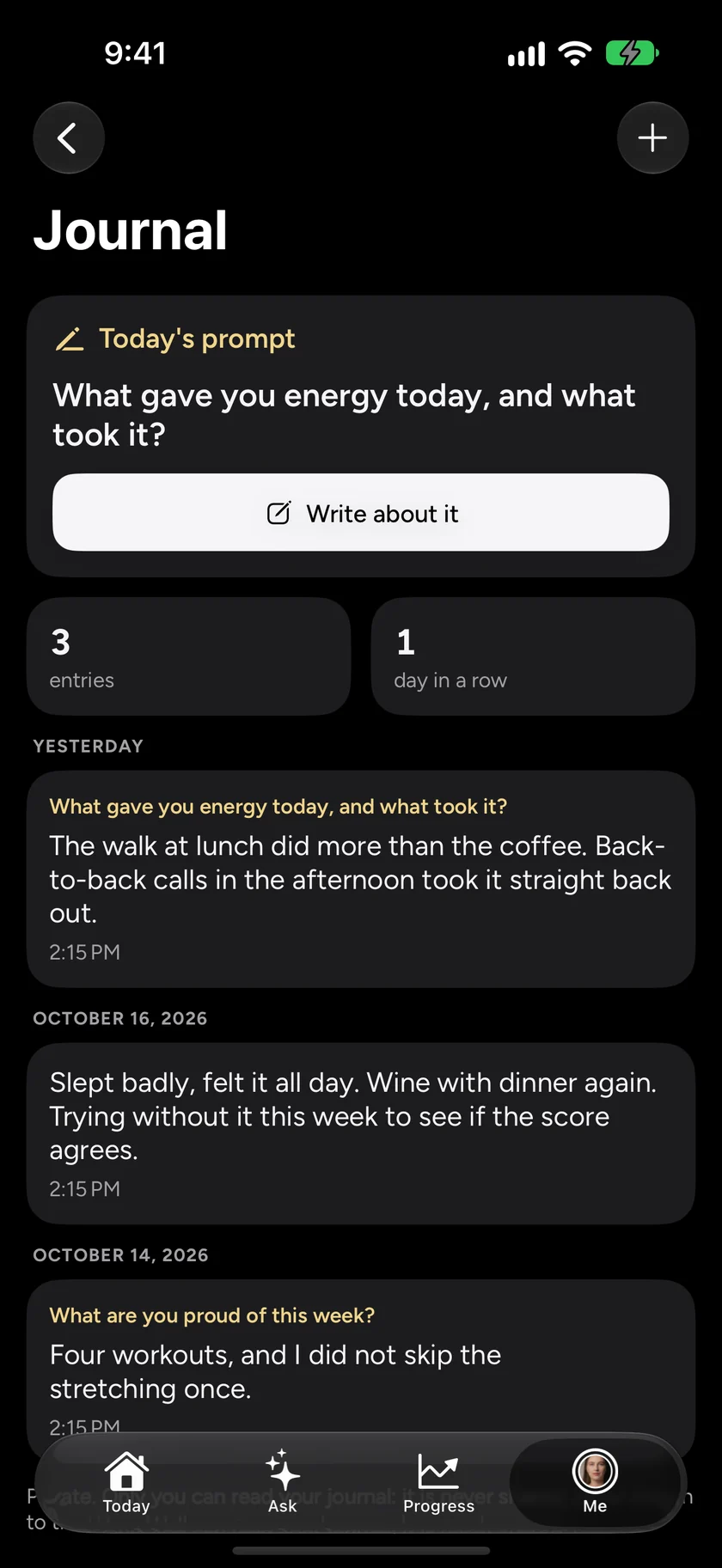
The rule that matters is printed on the page itself: the journal is never shown to the Wave Wellness team and never given to the coach.
The second half of that is a real trade-off, and worth being plain about. Wave’s coach would probably give better suggestions if it could read your journal. A line like “slept badly again, wine with dinner” is exactly the kind of context that explains a bad week. Wave keeps it out anyway. A journal that feeds an assistant is a journal with an audience, and within a few weeks you would be writing for it: a little tidier, a little more useful, a little less true. Better to have a coach that knows slightly less and a journal you can actually be honest in.
The same line holds for milestones. If you journal for two weeks running, that is a milestone you can see in Progress. It counts that you wrote. It never reads a word of it.
What “nobody” means, exactly
“Nobody reads it” is a rule about people and the coach, built into how the app works. It is not magic. Your entries are stored with the rest of your record on Cloudflare, encrypted in transit and at rest, with access written to an append-only log. Like everything in Wave, they are never sold or shared. Delete an entry whenever you want, delete your account and they all go, and ask through the contact form if you want a copy.
What no app can protect against is the person who picks up your unlocked phone. Lock your screen.
And a streak is a nudge, not a duty. A missed day costs nothing. The research never asked people to write forever; a few sessions were enough to see an effect. Write when there is something to write, and let the count take care of itself.
The version of the day you would never show anyone is the one worth writing. That is the whole design.
Wave Wellness is free on the App Store and Google Play. Download it and see how your own calm moves today.
Wave is for general wellness and is not a medical device. If what you find yourself writing about feels too heavy to carry alone, talk to a doctor or a counselor.