One of the most studied numbers in public health is not a lab value or a scan. It is a person’s answer to a single question: how would you rate your health? Excellent, good, fair, poor.
That answer turns out to predict how long people live, even after researchers account for their diagnoses and the other health measures in their records. Idler and Benyamini reviewed twenty-seven community studies on it in 1997, and the finding has held up in the decades since. Something in the way people feel about themselves captures information the chart does not.
So the usual hierarchy, where wearable numbers are “real” and feelings are noise, has it at least partly backward. How you feel is data. It is just data most apps do not bother to collect properly.
Feelings often move first
Sports science arrived at the same place from a different direction. Coaches have long had athletes fill in short questionnaires about mood, fatigue, soreness and sleep quality, and asked whether those answers tracked training load as well as objective measures did. A systematic review by Saw, Main and Gastin in 2016 found that the self-reported measures responded to changes in training more sensitively and more consistently than the commonly used objective markers.
The plain-language version: you often know you are run down before your blood work or your resting heart rate does. Not always, and not precisely, but often enough that ignoring it wastes a signal you carry around for free.
The catch is that feelings are slippery. They change with the hour, with the last email you read, with whether you have eaten. That is why a single bad afternoon means little and the pattern across weeks means a lot. The value of a feeling comes from recording it the same way, at the same rough time, day after day. Which means the format has to be fast enough that you will.
Ten seconds, five taps
Wave Wellness asks five questions in its check-in, each a single tap: how you feel (Rough to Great), your energy (Drained to Firing), your sleep (Awful to Deep), how you ate (Off plan to Dialed in) and how you moved (Nothing to Hard). There is an optional note. The whole thing takes about ten seconds.
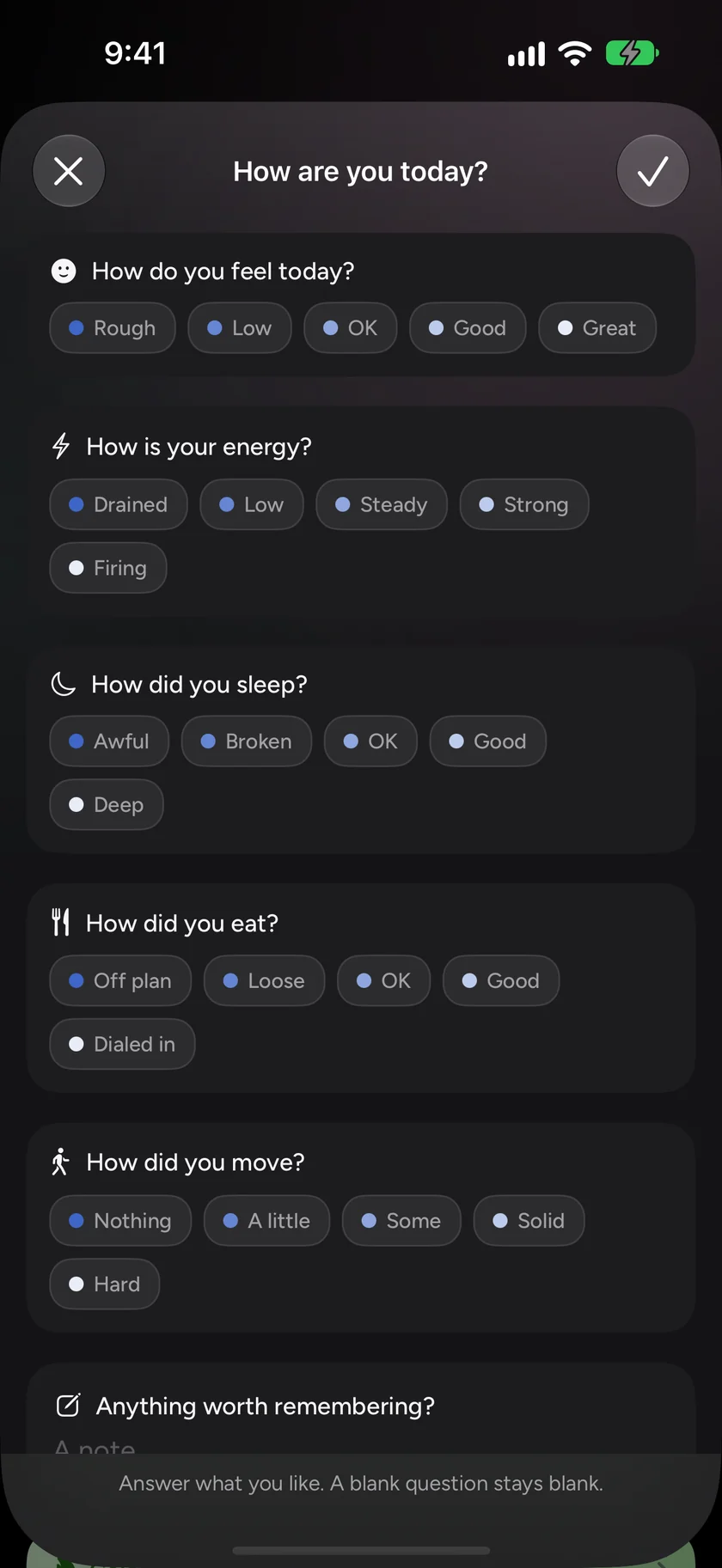
The interesting decisions are the small ones underneath.
Five is always better. Every scale runs 1 to 5, and 5 is the good end on every question, including movement, where “Hard” scores high. That sounds obvious until you see questionnaires where a high stress score is bad and a high energy score is good on the same page. Consistent direction means the daily average out of 5 actually means something, and a glance at your history reads the same way top to bottom.
A blank stays blank. If you skip a question, Wave stores nothing for it, not a 3. This is a bigger deal than it looks. Filling a gap with the middle value quietly pulls every average toward “fine” and makes a rough two weeks look calmer than it was. An honest record would rather know less than know something false. The sheet says it in one line: answer what you like, a blank question stays blank.
Blue, not red and green. The answers run along a ramp of blues, darker at the low end, lighter at the high end. There is no red for a bad day and no green for a good one. Red and green are the colors of lab reports and warning lights, and a person who tapped “Low” on a Tuesday does not need to be told, in alarm colors, that they failed. It is a log, not a test. Nothing reads as clinical because nothing here is.
Where the feeling goes
The check-in is not decoration on top of the “real” numbers. Your mood and energy feed Today’s Wave, the daily score, worth up to 15 points either way, alongside HRV, resting heart rate, sleep and yesterday’s training. The score is plain arithmetic, so the contribution is exactly that: a bounded, visible nudge.
The bound is deliberate. Fifteen points is enough that a morning when you feel flat registers even if your heart rate looks fine. It is not enough that one grumpy hour can override a body that is clearly recovered, or that a cheerful mood can paper over a short night. Feeling and physiology each get a say, and neither gets the whole vote.
Over time the answers do their best work as a pattern. Relax shows mood, energy and sleep side by side over fourteen days, and the check-in page keeps a two-week strip and every day’s average. A run of 2s is easy to dismiss one at a time. Seen as a row, it is a question worth asking.
What it cannot tell you
A check-in is self-report, with all that implies. It reflects the moment you tap it. It is shaped by what kind of day you expect to have, and by how honest you feel like being with yourself at seven in the morning. Two people’s 3s are not the same 3. That is why Wave compares you only with you, and why the weight on it is capped.
It is also not a mental health assessment. A low score is a note in your own log, not a finding, and the app says so on the page.
What it gives you is cheap, early and yours: ten seconds a day that turn a vague sense of “I’ve been off lately” into something you can actually look at.
Wave Wellness is free on the App Store and Google Play. Download it and see how your own calm moves today.
Wave is for general wellness and is not a medical device. If low mood or exhaustion lasts more than a couple of weeks, talk to a doctor.