Most people keep a quiet graveyard of goals. The step count that lasted two weeks. The half-marathon plan. The weight by the wedding. Most of them did not end with a decision. They ended with a slow fade, an app you stopped opening because opening it meant seeing how far behind you were.
There is a better way to think about what a goal is. Not a contract you signed with yourself, which you either keep or break, but a lens: a way of looking at the same record that brings one thing into focus for a while. Contracts get broken. Lenses get swapped. And swapping a lens should never cost you what you were looking at.
Letting go is a skill
Research on goals has spent far more time on persistence than on its opposite, but the opposite turns out to matter. Carsten Wrosch and colleagues (Wrosch, 2003) found that people who were better at disengaging from goals that had become unattainable, and at re-engaging with new ones, reported higher well-being. The useful trait is not grit alone. It is grit plus the ability to tell when a goal has stopped serving you.
That makes sense once you watch how a stuck goal behaves. A goal you no longer believe in does not sit quietly. It keeps producing small failures, and each “behind” is a little tax. People pay it for weeks rather than admit the goal has changed, partly from pride and partly because quitting feels like declaring the whole effort wasted.
Dieting researchers have a name for what often comes next, the “what-the-hell effect”: break the rule once and the whole day, or the whole plan, goes. A goal framed as a contract invites that. A lens does not, because there is nothing to break.
When the app holds your data hostage
Software makes this worse in a way that is easy to miss. In a lot of apps the data lives inside the goal. A challenge, a program, a plan: delete it and its history goes with it, or sits orphaned on a screen you will never find again. So the price of quitting is not just pride. It is the record.
That pushes behavior in exactly the wrong direction. People keep dead goals running to protect the data, which keeps the bad news coming. Or they delete them in a burst of tidying and lose months of readings that would have been useful the next time they tried.
The fix is structural, and simple to state: the readings belong to you and your record. A goal only reads them.
How Wave builds it
In Wave Wellness, a goal is a target laid over a number the app already keeps. You can aim at Wave Age, body weight, daily steps, sleep or workouts a week, and also at protein, resting heart rate, HRV, scans and water. You pick a value, add a date if you want one, and an optional note on why. The date really is optional, and the sheet says so plainly: “No deadline. A goal without one is still a goal.”
Each goal gets a verdict, On target, Close or Behind, and a sentence saying where you stand and over how many days. The words describe distance, not character. Close is not a polite word for failing. It is a measurement.
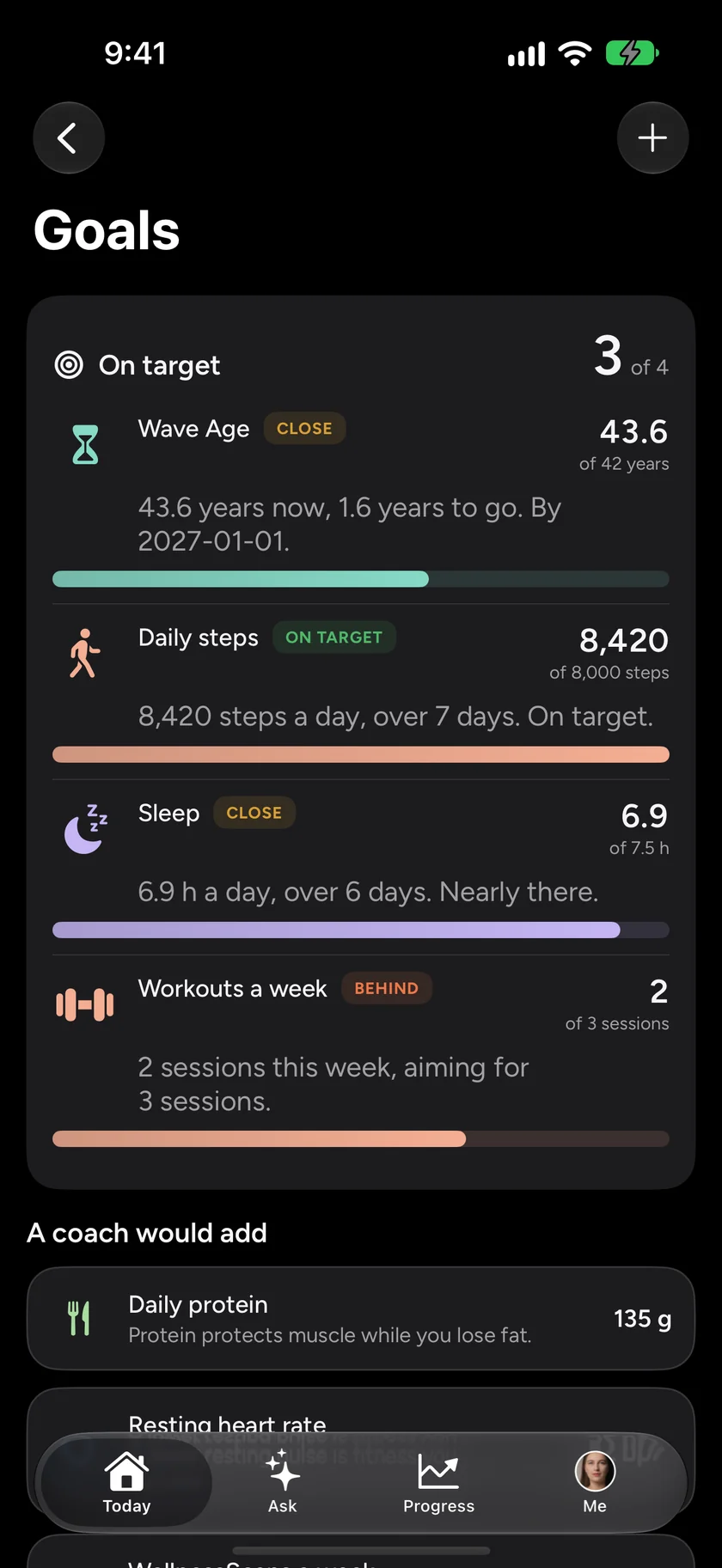
Below your goals sits “A coach would add”: targets you have not set, each with a one-line reason, such as daily protein because protein protects muscle while you lose fat. If you start from nothing, the defaults are ordinary and defensible: 1.6 g of protein per kg of body weight, 7.5 hours of sleep, 3 sessions a week, 8,000 steps.
And when you remove a goal, every reading stays. The steps from the months you were chasing 8,000 are still your steps. The weight entries you logged are still in your record. Nothing in the history depended on the goal existing. If you come back to it in the spring, the trend is waiting for you, longer than when you left.
Using goals as lenses
A few habits follow from treating goals this way.
- Hold fewer than you think. Four in focus beat ten in a list.
- Change a target when the evidence changes. If your life cannot give you 7.5 hours of sleep right now, set it to 7 rather than failing 7.5 every night.
- Swap lenses with the season. Steps in summer, strength sessions in winter. The data from both stays put.
- Read a lasting Behind as information. Once it is a pattern rather than a blip, it is telling you something about the goal, not just about you.
What a goal cannot do
A verdict is only as good as the number behind it. Wave can tell you that you are Behind on three sessions a week; it cannot tell you whether three was right for your life this month. The suggestions come with reasons, not with knowledge of your knees, your job or your kids. Reaching a goal is a milestone you can share, which is nice, but it is not the point. The point is the record underneath, and the habit of looking at it honestly.
Quit goals freely. Keep the record.
Wave Wellness is free on the App Store and Google Play. Download it and see how your own calm moves today.