A team of researchers once had young men lift weights twice a week for twelve weeks. After every session, half of them sat in cold water for ten minutes. The other half did ten minutes of easy cycling. At the end, the cold-water group had gained less muscle and less strength (Roberts, 2015).
Nobody in that study did anything wrong. They used a recovery habit that plenty of athletes swear by, exactly as intended. It just answered a different question from the one they cared about.
Two questions that sound like one
“Am I recovered?” usually means two things at once. The first is short-term: are you ready to train again, without lingering soreness or heavy legs? The second is long-term: did the last session leave you any stronger, fitter or more muscular than before?
Most of the time the answers point the same way. Sleep well, eat enough protein, space out your hard days, and you feel better and adapt better. But the two can come apart, and when they do, how you feel tomorrow is the less important answer.
Some of the soreness is the signal
A hard session is a stress the body reads as a request. The ache and the inflammation in the hours afterward are not only damage to be cleared away. They are part of how a muscle registers that it was asked for more than it had, and starts building.
Cold water dampens that response, which is why it feels good. A Cochrane review (Bleakley, 2012) found that cold-water immersion may reduce next-day soreness compared with simply resting, though the studies were small and the evidence weak. In the Roberts work, the dampening showed up inside the muscle too, where the signaling that drives growth was reduced after the cold. Less soreness and less growth turned out to be two sides of one effect.
None of this makes cold water bad. With a match tomorrow, or two sessions in one day, short-term readiness is the question that matters, and the trade may be worth it. For endurance training the evidence is thinner and more mixed. The useful point is narrower: judge a recovery tool by which question it answers, because the one you can feel is not always the one that counts.
The fast answer and the slow one
That gives you a simple test for anything sold as recovery, from compression boots to a supplement to a nap. Ask what it changes the morning after, then what it changes in three months. Notice that nearly all of the marketing is about the first.
The morning answer is easy to feel. The three-month answer is not. Strength creeps up a few pounds at a time, and muscle takes months to show. Nobody notices adaptation on the day it happens, which is how a tool that makes tomorrow feel better can win the argument while quietly losing the one that matters.
How Wave reads each one
Wave Wellness keeps the two questions apart.
Today’s Wave answers the morning one. It is a number from 0 to 100, read against your own previous 30 days: HRV, resting heart rate, last night’s sleep, yesterday’s strain against the week before, and how you said you feel in the check-in. It tells you whether to go all out, hold steady or take it easy, and it names the two inputs that moved it most.
What it does not tell you is whether yesterday’s session made you stronger. No morning reading can.
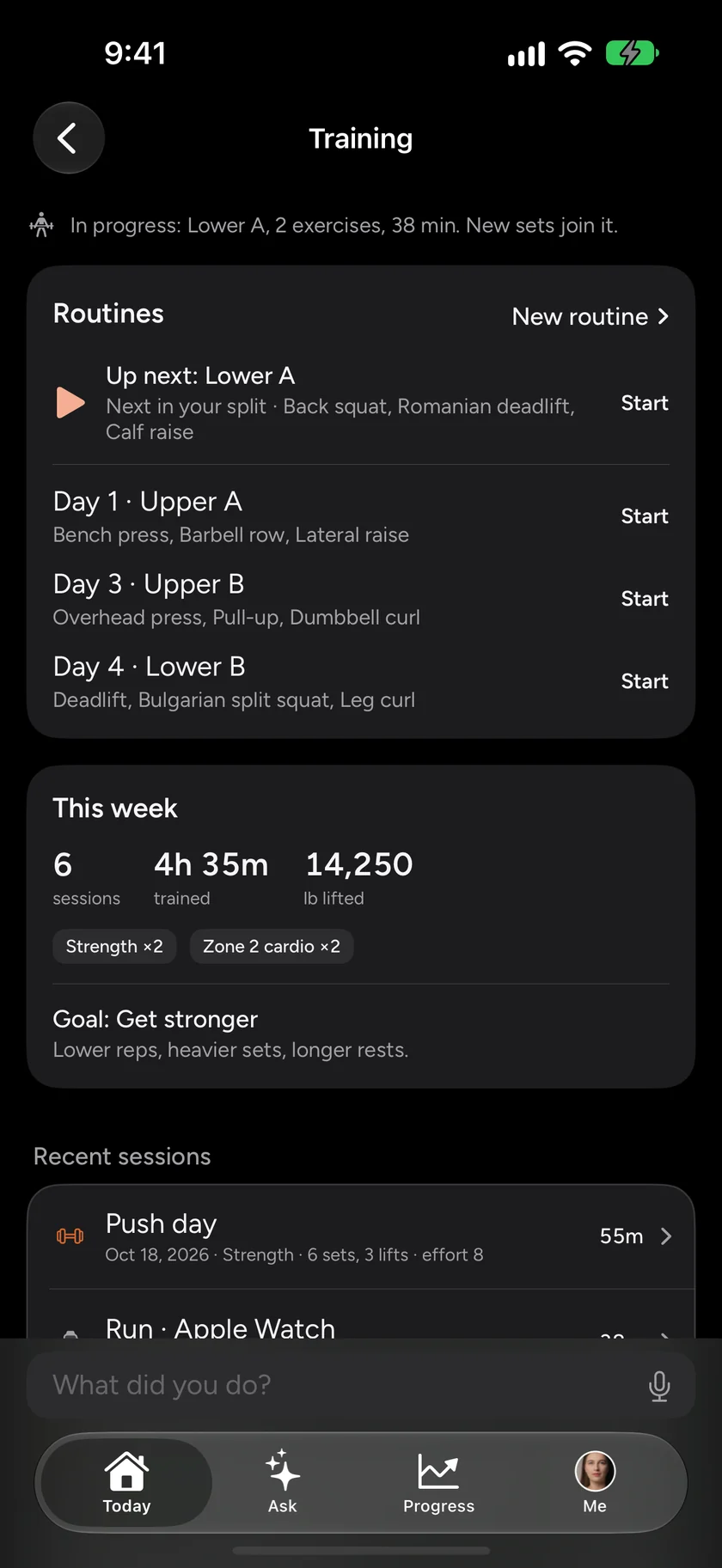
The slow question lives in your training record. Strength sessions keep every set, lift and effort rating, Apple Watch workouts arrive on their own, and every routine opens with the weights you lifted last time. Week after week, that is a running record of whether the work is going up. Over months, it is the honest answer to “am I adapting?”
Wave Age takes the long view as well. Strength training once or twice a week is one of its inputs, worth about 15 percent lower risk in the research it draws on (Momma, 2022). It counts the sessions you do, not how sore you were after them.
What Wave cannot see
Wave does not measure inflammation, soreness or muscle growth. It reads your heart, your night and what you tell it. A good score the morning after a cold plunge says you look ready, not that the plunge helped you build anything. And a lift log only answers the slow question if the sessions are logged and the weights are real.
Learn, the app’s shelf of three-minute reads, rates popular practices such as cold plunges as Strong, Mixed, Early or Weak, with the date the evidence was last checked. That is general education, not advice about you.
The idea works without any app. When something promises faster recovery, ask whether it helps you feel ready or helps you get better, and do not assume it does both. If you keep using it, look for the answer where it actually shows up: in what you can lift three months from now.
Wave Wellness is free on the App Store and Google Play. Download it and see your own training record today.
Wave is for general wellness and is not a medical device. It does not diagnose or treat anything; talk to a doctor before trying cold-water immersion if you have a heart or blood pressure condition.