A lab report looks like text. It is not. It is a picture of a table, laid out for a person who will run a finger along a row: the test name on the left, the result in the middle, a flag in its own narrow column, the reference range on the right, the units somewhere near. Everything on the page means something because of where it sits.
That is the whole engineering problem with turning a lab sheet into data, and it is easy to miss until you watch it go wrong.
What flattening does to a table
The classic way to get words off an image is optical character recognition, and at its core OCR answers one question: what characters are on this page? It is very good at that. What it hands back, in its simplest form, is a stream of text in reading order, left to right, top to bottom, with the layout reduced to line breaks and spaces.
For a letter, that is fine. For a table, the layout was the meaning.
Picture a typical row. “Glucose” on the left, “112” in the middle, then a gap, then “H” in a flag column, then “65-99”, then “mg/dL”. Now picture the row above it with no flag at all, and a footnote marker squeezed against the result in the row below. Read out as a stream, the H is just a letter floating between numbers. Whether it belongs to glucose, to the line above, or to nothing depends on spacing that the stream has thrown away. A short flag in a column of its own is exactly the thing most likely to come loose.
The same loss shows up in quieter ways:
- A reference range like “3.5-5.0” is a pair of numbers that look exactly like results.
- A report that runs in two columns can be read straight across, splicing the left marker to the right marker’s value.
- A unit that sits in a header instead of on each row has to be carried down the table by something that understands the table.
- A decimal point is one small dot. Lose it and 5.0 becomes 50.
None of this is exotic. Every lab formats its own.
The worst case is a fax
Then there is the version many people actually have: a sheet that was printed, faxed, printed again and photographed on a kitchen counter. Faxing was built for legible text at low resolution, and it shows. Thin lines break up, a 3 and an 8 start to resemble each other, the page arrives slightly rotated, and a phone photo adds shadow, curl and perspective on top.
On a page like that, character-level reading gets noisier, and layout-blind reading gets worse, because the rows themselves are no longer straight. The table is still obvious to a person. It is the stream of characters that has stopped making sense.
How Wave reads it
So Wave Wellness reads the sheet the way you would: as a page. You photograph it (a scanned fax is fine), upload a PDF, or type the values in. When Wave reads a photo or a PDF, it works from the image of the page rather than a flattened transcript of it, so a value stays attached to its row, and a flag stays beside the number it was printed next to. That is the reason for the design, and it is a specific one: some labs flag abnormal values by column, and flattening the page loses the flag.
Reading the page well is half the job. The other half is admitting that nothing that reads a page, human or machine, is perfect on a crooked fax.
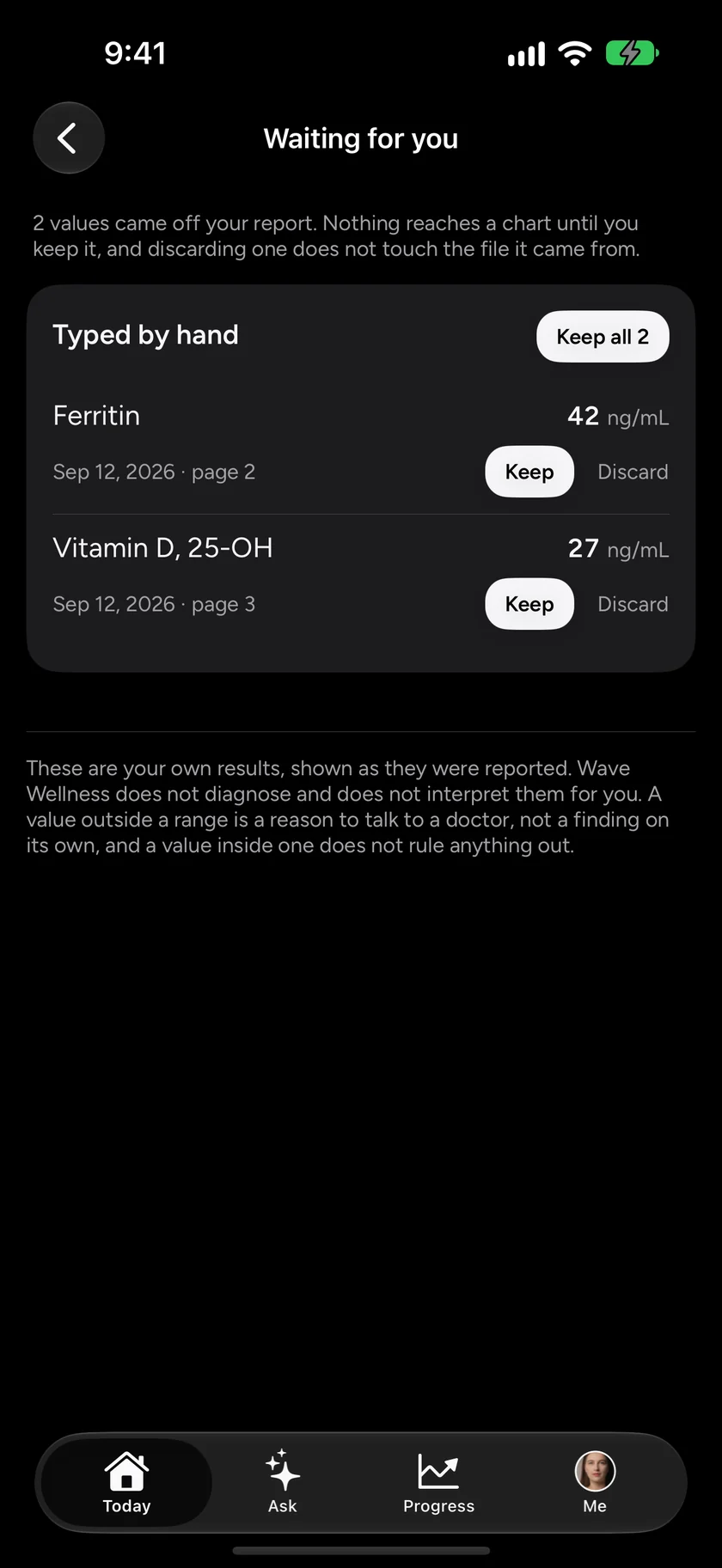
Every value Wave takes off a report waits for you first, shown beside the page it came from. You keep it or discard it, one by one, or tap Keep all. Discarding a value does not touch the file it came from. And the rule underneath it all is written into the screen: nothing reaches a chart until you have kept it. Once kept, a value joins a catalog of 52 markers, gets its label (in range, borderline, optimal or out of range) and takes its place in Trends.
Why a person stays in the loop
Skipping that step and plotting whatever came off the page would be faster. It would also be the wrong design, for three reasons.
Extraction errors are silent. A misread value does not look misread. A 50 that should have been 5.0 sits in your history with the same confidence as every correct number around it. Worse, a single bad point in a trend does not stay put: it bends the line, moves an average, and turns a steady marker into an apparent spike that you might worry about for months.
The cost is lopsided. Checking a value against the spot it came from takes a second or two when the two are side by side. Finding a wrong number later, after it has been charted, compared and maybe brought to an appointment, costs far more, if it is found at all.
You are the best checker available. You know which lab you went to, roughly what your numbers usually are, and whether that page 3 was even yours. The software knows none of that. A review step that shows the source makes your knowledge useful at the moment it matters, rather than asking you to trust a summary.
There is a known trap here, sometimes called automation bias: people tend to wave through what a machine proposes. The defense is design, not willpower. Show the value next to its origin, make discarding as easy as keeping, and never let an unreviewed number into the record by default. A confirmation step that just says “Looks good?” over a list of numbers invites a reflexive yes. One that shows you where each number came from invites a glance, and a glance is all it usually takes.
What it does not do
The review step is not a guarantee. If you tap Keep all on a sheet you did not look at, Wave will believe you. And reading a sheet correctly is not the same as interpreting it: Wave shows your results as they were reported and does not diagnose or tell you what they mean. A value outside a range is a reason to talk to a doctor, not a finding on its own, and a value inside one does not rule anything out.
What the design does promise is narrower and more useful: the numbers in your record are the numbers on your page, and you saw each one go in. A health record is only as good as its worst entry. The cheapest place to stop a bad one is the door.
Wave Wellness is free on the App Store and Google Play. Download it and see all of it working together today.
Wave is for general wellness and is not a medical device. It does not diagnose or treat anything; talk to your doctor about your lab results.