Open almost any kitchen cabinet and the evidence is right there: a bottle of magnesium two-thirds full, a vitamin D that expired last spring, a tub of something a podcast recommended, opened twice. Nobody decided to stop taking them. They just stopped.
People argue for hours about which supplement, which brand, which form. Almost nobody asks the duller question that decides most of the outcome: did you take it?
The variable that goes missing at home
A trial of a supplement measures what happens when people take it as directed, every day, for weeks or months. Participants are reminded, their pills are counted, and the people who drift off are tracked. The result that gets quoted in an article or on a label is the result of taking it.
At home, the taking is on you, and people are not good at it. A World Health Organization report in 2003 put adherence to long-term therapies in developed countries at around 50 percent, and that is for prescribed medicines, with a doctor paying attention. There is little reason to think the bottle you chose for yourself does better.
How much a missed dose matters depends on what you are taking. Some things are forgiving of a skipped day. Others depend on steady intake: creatine, for instance, works by building up stores in muscle over weeks of daily use, and an on-again, off-again pattern builds them more slowly. Timing quietly changes the dose, too. Vitamin D is fat-soluble and is absorbed better alongside a meal with some fat in it, so the capsule swallowed with black coffee at 6 am is not quite the same as the one taken with breakfast.
Then there is plain confusion. Was this one with food or without? Morning or bedtime? Did I already take it today, or was that yesterday? Every one of those questions, unanswered, ends in either a missed dose or a doubled one.
Evidence comes in grades
The second variable is whether the thing works at all, and the honest answer varies enormously by product. Some supplements have years of consistent trials behind them. Some have a few small studies. Some have a plausible mechanism and a marketing budget. In the US, supplements do not need FDA approval before they are sold, so being on a shelf says nothing about the evidence behind it.
It helps to think of the evidence behind a supplement in rough grades, from strong and consistent down to early or weak, and to remember that a grade carries a date, because the evidence moves. That is general knowledge about the research, not advice about you.
Put the two variables together and the arithmetic is unkind. A supplement with weak evidence, taken half the time, is a small bet made smaller. One with strong evidence, taken half the time, is half of a good idea. Very often, the cheapest improvement is not a better product. It is taking the one you already chose.
What Wave does with it
Supplements and meds in Wave is built around the taking, not the buying. Each entry keeps its dose, its form and its timing slot: morning, midday, evening or bedtime. Those slots become a daily checklist, grouped by time of day, and you tap the circle when you take it.
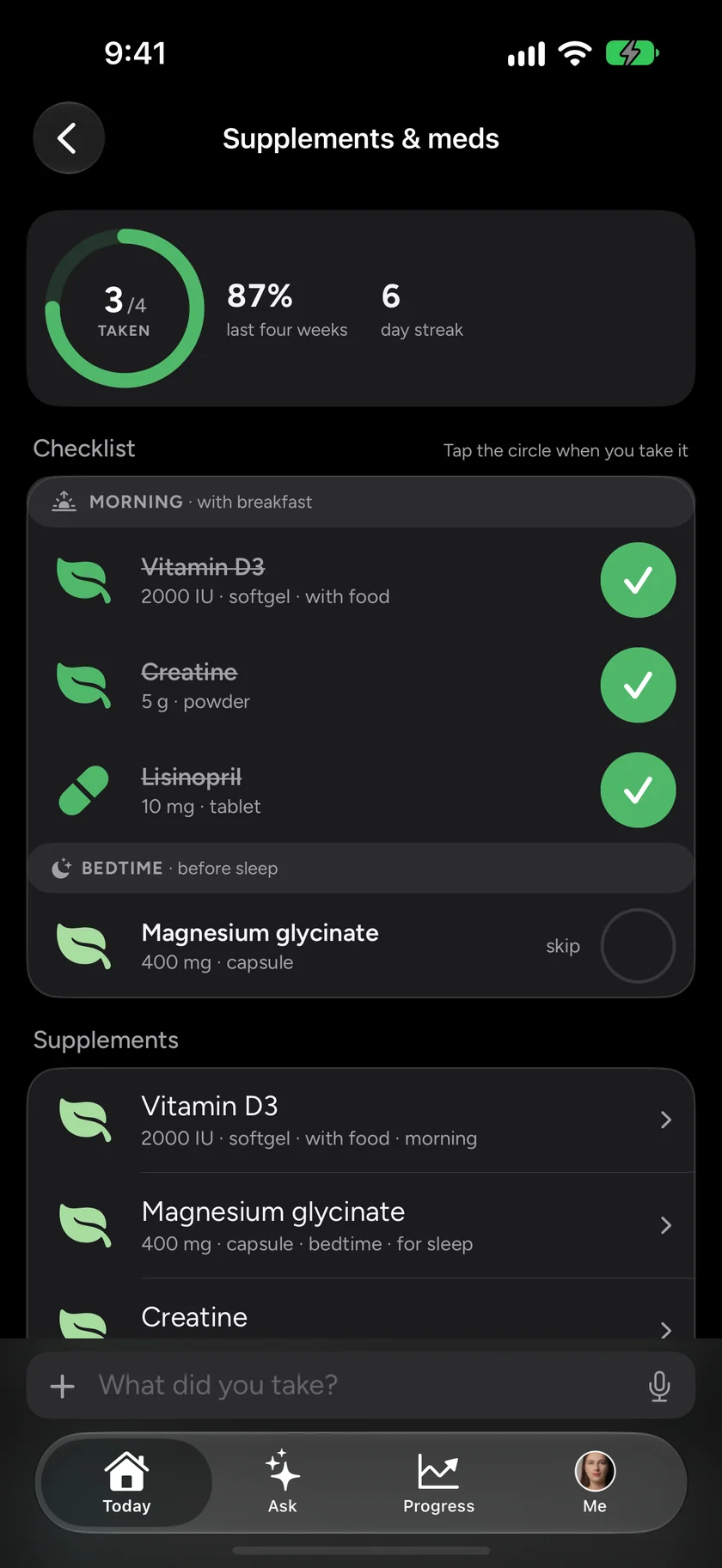
Above the checklist sit two numbers: a streak, and your adherence over the last four weeks as a percentage. The percentage is the honest one. A streak breaks loudly once and then hides the pattern; four weeks of adherence shows whether “I take it every day” is true.
Getting things in is meant to be quick. Photograph the label and Wave reads it. Scan a barcode and it is looked up against NIH’s Dietary Supplement Label Database, openFDA and Open Food Facts. For a prescription, photograph the label on the vial. Or just say it in the Wave AI box, “magnesium at bedtime”, and confirm the entry before it is logged.
What the number is for
The adherence figure answers the question you need before any other: before deciding a supplement does nothing for you, did you actually take it, at the right time, for long enough? If the answer is 60 percent, you have not tested it yet. It works the other way too: at 95 percent for a fair stretch, with nothing to show for it, you have learned something real, and that is worth a conversation about whether to keep paying for it.
It also makes for a better appointment. A list of every supplement and medicine, with dose, form and timing, is exactly what a doctor or pharmacist asks for and what most people recite from memory, badly.
What Wave will not do is tell you what to take or how much. It keeps the record; the choices are yours and your doctor’s.
Wave Wellness is free on the App Store and Google Play. Download it and see your own meals today.
Wave is for general wellness and is not a medical device. It does not diagnose or treat anything. Some supplements interact with prescription medicines, so talk to your doctor or pharmacist about everything you take before you start or stop anything.