Here is a morning that happens more often than you would think. You wake up dreading the day: a hard meeting, a bill, a conversation you have been putting off. You check the stress reading on your phone and it says Calm.
Here is the opposite one. You feel fine, a bit flat maybe, nothing worth mentioning. The reading says Strained. Two days later you have a cold.
Neither reading is broken. Each is answering a different question from the one you asked. “Stress” covers two things that overlap less than the word suggests: what you feel, and what your nervous system is doing. A stress score reads the second. The first still counts, and it is worth knowing which is which before you trust either.
Two kinds of stress, loosely linked
The felt kind is appraisal: your mind’s running estimate of what is being asked of you against what you have to give. Deadlines, worry, conflict, the sense of too much. It is real, it matters for health over time, and only you can report it.
The physiological kind is load on the body. Your autonomic nervous system, the part that runs heart rate and breathing without asking you, shifts toward alert when the body is dealing with something: hard training, a short night, alcohol, heat, an infection getting started, and yes, sometimes a worried mind.
You might expect the two to move together. Often they do not. Studies that put people through a standard lab stress test, and measure both how stressed they say they feel and how their bodies respond, tend to find the two only loosely connected. Some people feel rattled with a modest physical response; others report feeling fine while their heart rate and stress hormones clearly react. Neither person is wrong about themselves. They are reporting from two different channels.
So a score that disagrees with your feeling is not necessarily a bad score. It may be telling you something your feeling cannot, or missing something only your feeling knows.
What the number actually reads
The stress index in Wave Wellness reads exactly two signals: heart-rate variability and resting heart rate, from your wearable or from a morning WellnessScan. Both are compared with your own recent usual, not with a population average.
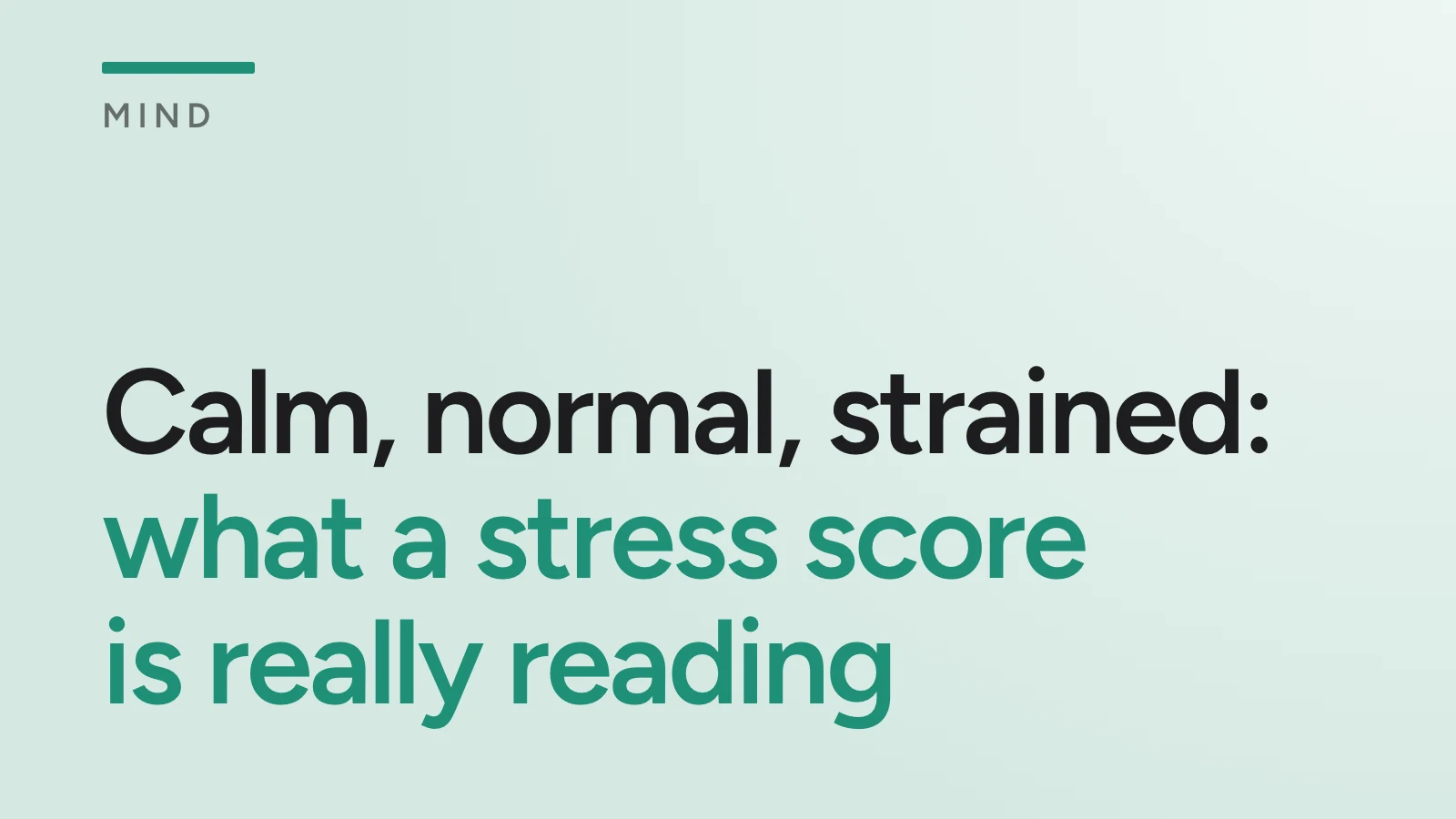
The index starts in the middle, at 50. HRV running below your usual pushes it up, and so does a resting heart rate running above your usual; the reverse pulls it down. The result is a number from 0 to 100 and one of three words: Calm under 35, Normal from 35 to 65, Strained over 65.
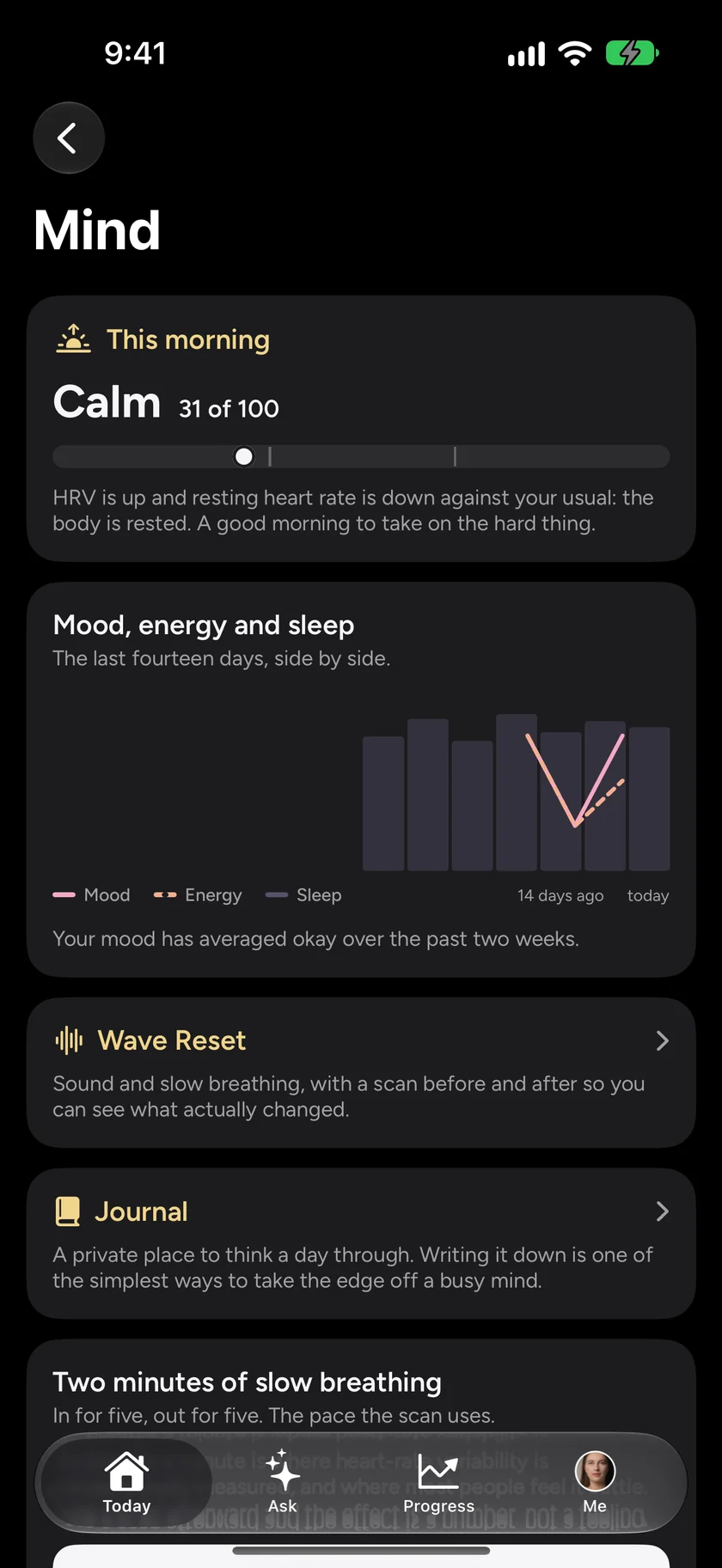
What it leaves out is as deliberate as what it includes. Sleep feeds the daily score, Today’s Wave, but not the stress index: the code reads the two nervous-system signals only, whatever the sleep said. Your check-in mood is left out too. That keeps the index a clean read of one channel. If it blended in how you said you felt, a Strained body on a cheerful morning would be averaged into Normal, and the most useful disagreement of all would disappear.
Instead, the feeling sits beside it. The same screen shows mood, energy and sleep from your check-ins over the last fourteen days, side by side, so both channels are in view and neither dilutes the other.
Reading the two together
Put a body reading next to a felt one and you get four kinds of morning, each pointing somewhere different.
- Calm body, stressed mind. Your system has capacity. The pressure is in the situation, not the tank. A good morning to take on the hard thing.
- Strained body, fine mind. The one worth respecting. Something is costing you that you have not noticed yet: last night’s drinks, a big week of training, maybe the start of a bug. Ease off and look again tomorrow.
- Both strained. Pressure on both channels. Protect sleep, keep training easy, drop what you can.
- Both calm. Enjoy it, and notice what you did yesterday.
None of these is a diagnosis. They are prompts for where to look.
Two minutes, then look again
Below the reading sits the simplest thing Wave offers: “Start two minutes.” In for five, out for five, six breaths a minute, the same pace the scan’s breathing coach uses. Slow breathing at about that rate is one of the few relaxation techniques that reliably shows up on the heart, and Wave scans you afterward, so the effect is a number and not just a feeling. For something longer there is Wave Reset, with a scan before and after.
This is where the two channels meet again. You can feel calmer after two minutes, and then see whether your body agrees.
What it cannot tell you
The index cannot tell you why. Alcohol, illness, a heavy session, a hot bedroom and an argument at dinner can all produce the same Strained reading, because they all move HRV and resting heart rate the same way. You supply the why; your check-in notes and journal help.
It is a morning snapshot, not a stress meter running through the day. It means more once your baseline has a few weeks in it, and it needs an HRV reading to exist at all: with no morning signal, it shows nothing rather than a guess. And it is not a measure of anxiety or of mental health. A Calm reading does not mean you are fine if you do not feel fine.
The useful habit is to stop asking which number is the true one. Your body and your mind are both reporting. Listen to both, and pay the most attention when they disagree.
Wave Wellness is free on the App Store and Google Play. Download it and see how your own calm moves today.
Wave is for general wellness and is not a medical device. If stress, worry or low mood has been shaping your days for more than a couple of weeks, talk to a doctor.