There are two witnesses to every night you sleep, and they are both a little unreliable.
One is the device on your wrist or finger. It was awake the whole time, which is its great advantage, but it cannot see your brain; it infers sleep from movement and heart rhythm. The other is you. You know exactly how the morning feels, but you were unconscious for the part in question, and your memory of the night is a reconstruction.
Most sleep apps pick a winner. The device’s number goes at the top in large type, and how you felt, if it is recorded at all, becomes a footnote. That loses something important, because the most informative mornings are the ones where the two witnesses disagree.
What the device actually knows
The gold standard for measuring sleep is polysomnography: a night in a lab with electrodes on the scalp reading brain waves directly. Sleep stages, light, deep and REM, are defined by those brain waves. A ring or a watch has no access to them. It estimates them from what it can read: how still you are, your heart rate, the rhythm of your heartbeat, sometimes skin temperature and breathing.
Validation studies against the lab tend to land in the same place. Consumer devices are fairly good at telling asleep from awake, and fairly good at total sleep time. They are much less reliable at telling one stage from another on a given night. A common error runs in one direction: lying still and awake looks a lot like sleep to a sensor, so devices can count quiet wakefulness as sleep.
None of that makes the device useless. It is consistent, it is there every night, and it is far better at trends than at any single reading. But “1h 12m deep sleep” is an estimate with a margin, not a measurement, and it deserves to be labeled as one.
What only you know
Your own account is unreliable in a different way. People routinely misjudge how long they took to fall asleep and how long they lay awake in the night, and some people consistently feel they slept far less than a lab shows they did.
Yet “how did it feel” is not a lesser question. It is the question. You do not sleep to produce a good stage chart; you sleep to function the next day. Research on self-rated health has long shown that how people feel carries real information beyond what the measurements catch, and sleep is no exception. The device can tell you how long. Only you can tell it whether that was enough.
There is also a known hazard in letting the device win every argument. Sleep researchers coined a word, orthosomnia, for people whose pursuit of a perfect tracker score made their sleep worse (Baron, 2017). Anxiety about the number became the problem. A record that keeps your own judgment in the frame is some protection against that.
The gap is the signal
Put the two side by side and the disagreements start to mean something.
Slept eight hours, feel awful. The quantity looks fine, so the problem is probably quality or timing. A late drink that fragmented the second half of the night. An afternoon coffee that thinned out deep sleep. A bedtime two hours later than usual, so the eight hours fell at the wrong time for your body clock. The early days of a cold. Or the device was wrong and counted an hour of restless lying-still as sleep.
Slept six hours, feel great. Fine once. A run of these is worth noticing, because short sleep tends to feel more tolerable than it is; people adapt to how tired they feel faster than their performance recovers.
Both say bad. Then you can believe it, and it is a clear reason to take today easier.
Neither witness alone can tell you which of these nights you had. Together they narrow it down.
Two labels, never one blend
Wave Wellness keeps the two accounts side by side and labels each for what it is. On the Sleep page, the device gives duration and stages; you give how the night felt and when you went to bed. A night recorded from both shows “wearable + you”, next to “felt ok” and the times; a night that came only from Apple Health says so.
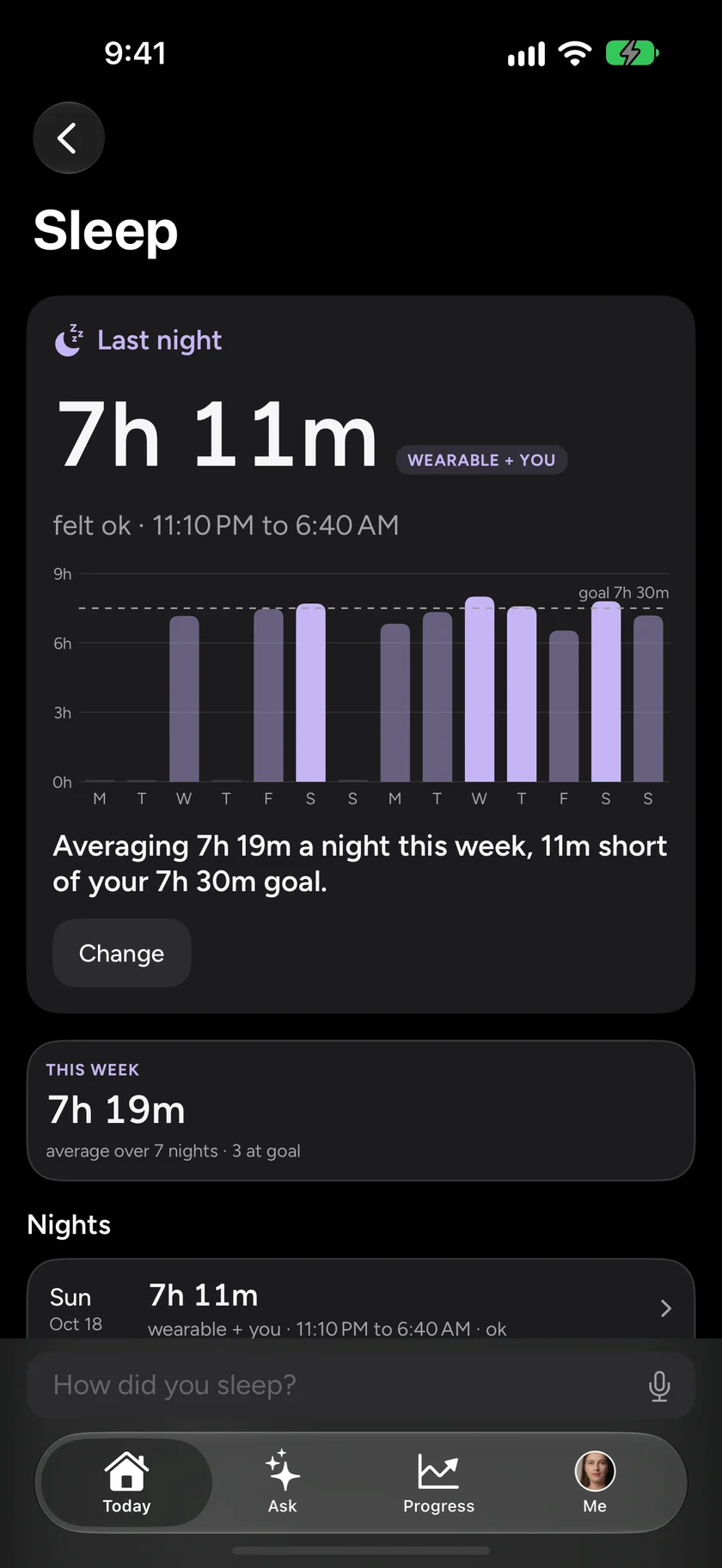
One does not overwrite the other, and they are never averaged into a single “sleep quality” figure. That is deliberate. A blend of a sensor estimate and a feeling is neither: you cannot check it against anything, and you cannot tell which half moved it. Kept apart, each stays honest about where it came from.
If you wear nothing, the record still works. You log the night yourself and it is labeled as yours. If you wear a ring, watch or band through Apple Health, or WHOOP directly, its numbers arrive on their own and sit beside your note. Your morning check-in adds a sleep rating, Awful to Deep, alongside mood and energy, so the feeling side builds a history as long as the device side.
Reading it well
A few habits make the comparison worth having. Note how the night felt before you look at the device’s verdict, so the number does not tell you how you feel. Read the past two weeks rather than the night; both witnesses are noisy, and a pattern across two weeks is worth far more than any one disagreement. And when they disagree, ask what happened yesterday before deciding which one is lying.
The device knows what happened. You know what it was worth. A good sleep record keeps both, and tells you which is which.
Wave Wellness is free on the App Store and Google Play. Download it and see your own sleep today.
Wave is for general wellness and is not a medical device. Its sleep figures are estimates, not clinical measurements; if you are persistently exhausted however long you sleep, talk to a doctor.