There is a quiet assumption in wellness that getting healthier starts at a checkout page. Buy the ring, the watch, the band, and the data will do the rest. It is an appealing idea, because buying something feels like doing something. But a device has never changed anyone’s sleep. What changes sleep is going to bed at the same time, and the device can only tell you whether you did.
So before the question of which wearable, there is a better one: what decision would its numbers change? If the answer is “none yet,” you do not need one. If you can name the decision, you will know exactly what you are paying for.
Wave Wellness was built to work either way, and to be honest about the difference.
What a phone already gives you
A phone in your pocket is a surprisingly capable sensor. With nothing else, Wave works from:
- Steps, counted by the phone itself.
- Sleep you log: when you went to bed, when you got up, how it felt. Your own report of how a night felt is not a lesser signal; it is a different one, and no device can measure it for you.
- The check-in: five one-tap questions, about ten seconds, starting with how you feel and how much energy you have.
- Meals, by search, barcode, a photo of the plate, or by saying them to Wave AI.
- The WellnessScan: about forty seconds with the front camera that reads heart rate, heart-rate variability and breathing rate from the color of your skin.
That last one is what makes the phone-only version work. Today’s Wave, the daily score, is built from HRV, resting heart rate, sleep, yesterday’s strain and the check-in, each read against your own baseline. Without a wearable, the morning scan stands in for the heart numbers. It also gives a stress index, Calm, Normal or Strained, from your HRV and resting heart rate. That is a real reading of your nervous system each morning, from something you already own.
It is a camera, not a strap, and the app says so: a chest strap is far more precise than any camera. But a scan you take every morning beats a device you stopped charging in March.
What a wearable actually adds
The honest answer is the night.
A scan is a snapshot. You take it awake, sitting up, at one moment in the morning. A ring, a watch or a band is there for the eight hours you are not, and the night is when your body is easiest to read: no posture changes, no coffee, no conversation, nothing but your baseline physiology.
Three things come from that:
Overnight HRV. Measured across hours of sleep rather than forty seconds awake, HRV is steadier, because sleep removes most of the noise. Day-to-day changes stand out more clearly against your baseline.
Resting heart rate, properly resting. The lowest stretch of your heart rate during sleep is about as close to a true resting number as you can get. A morning scan is close; the night is closer.
Sleep stages. Your own log can say when you slept and how it felt. A device can estimate how long you spent in light, deep and REM sleep, from movement and heart rhythm. Those are estimates, reasonable ones, not a sleep lab. But they can show patterns a log never will, such as REM pushed late after an evening drink.
Beyond the night, a wearable records workouts and active burn without you lifting a finger.
If those are the decisions you want to make (whether to push hard today, whether your bedtime routine is working, whether a late meal is costing you deep sleep), a wearable earns its place. If they are not, the phone covers you.
What connects today, exactly
Here is the list as it stands, with no hedging about the parts that are not finished.
Apple Health is live on iPhone. Wave reads from it and never writes to it.
Apple Watch workouts arrive automatically, and Today’s Wave and Wave Age appear on the watch itself.
WHOOP is connected directly: recovery, HRV, resting heart rate, blood oxygen, skin temperature, respiratory rate, strain, sleep stages and workouts. (WHOOP has no step counter, so steps still come from your phone.)
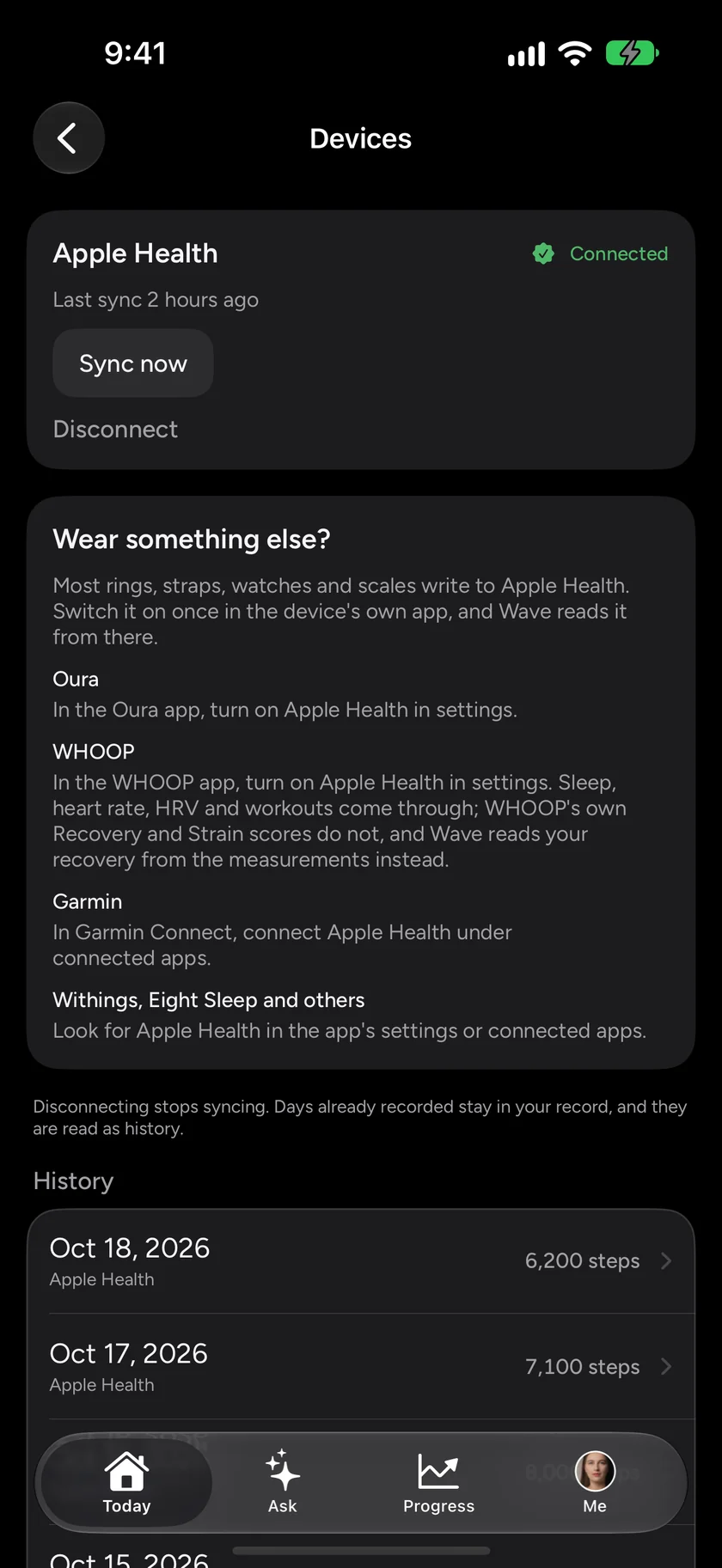
Oura and Garmin are live on iPhone through Apple Health. Their own composite scores, Oura’s Readiness and Garmin’s Body Battery, stay in their own apps; Wave works from the measurements underneath.
Health Connect on Android carries Samsung Health, Google Fit and most bands and rings. Fitbit is not offered. Without a wearable, the phone on its own still works, as above.
Whichever device you use, Sleep labels its data separately from your own log. The device gives duration and stages; you give how it felt and when you went to bed. One does not overwrite the other.
Buy it for a question, not a feeling
None of this is an argument against wearables. They are remarkable, and the overnight data is genuinely better than anything a camera can do in the morning. It is an argument for buying one the way you would buy any instrument: because you have a question it answers.
Start with the phone. Do the check-in, take the scan, log your nights for a few weeks. If you find yourself wanting to know what happened while you were asleep, that is the question a wearable answers, and Wave will read it the day you connect it. If you never do, you have saved the money and lost nothing that mattered.
The habit was always the part that made you feel better. The device just keeps score.
Wave Wellness is free on the App Store and Google Play. Download it and see all of it working together today.
Wave is for general wellness and is not a medical device, and its readings are estimates, not clinical measurements.