“If you are not paying, you are the product” has been repeated so often that it sounds like a cliché. Clichés become clichés by being true a lot of the time. This one deserves to be taken seriously, especially by anyone about to hand an app their heart rate, their sleep and their bloodwork.
So here it is, taken seriously: how free apps usually make money from you, and what it costs a free health app to refuse.
How the usual model works
Most free apps are not selling a spreadsheet of your name and diagnosis. The machinery is quieter than that, and mostly invisible from the screen.
It starts with third-party code. Building an app from scratch is slow, so developers drop in ready-made kits for analytics, crash reports, sign-in and advertising. Each kit is someone else’s software running inside the app, and many of them report back to the company that wrote them: what screen you opened, how long you stayed, what you tapped.
Then there is the advertising identifier, a code your phone exposes so that ad systems can recognize the same device across different apps. It is what lets an app you used this morning and a game you open tonight be understood as the same person. On its own it is just a string of characters. Joined to everything else, it is a profile.
And behind both sits a market. Data about behavior gets bought, combined and resold by companies most people have never heard of, and the word that is supposed to make this safe, “anonymized”, is weaker than it sounds. Researchers showed long ago that a handful of ordinary facts, such as a ZIP code, a birth date and a sex, are enough to single out most Americans (Sweeney, 2000). Add a few weeks of when you sleep and where your phone spends the night, and “anonymous” stops meaning much.
Health data makes all of this sharper. The medical privacy rules that bind your doctor generally do not reach a consumer app you download yourself. An app that knows you are sleeping badly, drinking more and checking your blood pressure knows things an advertiser would pay for, and in many cases nothing but the app’s own choices stands in the way.
The question is not free versus paid
Here is the part the cliché gets wrong. Paying does not, on its own, protect you. A paid app can carry the same kits and the same identifiers. Price tells you one thing about a business. What it is selling, and to whom, tells you the rest.
So the better question for any app is: who is the customer, and what exactly do they receive?
There is an old, unglamorous answer that predates the internet. A magazine runs an ad on page 40. The advertiser pays for the page. They get the page, and a count of how many copies went out. They do not get your name, your address or what you read on page 39. You are the audience, not the inventory.
How Wave pays for itself
Wave Wellness is free, always: no subscription, no upgrade wall, no card. It is paid for by advertising, and it works much more like the magazine than like the usual app.
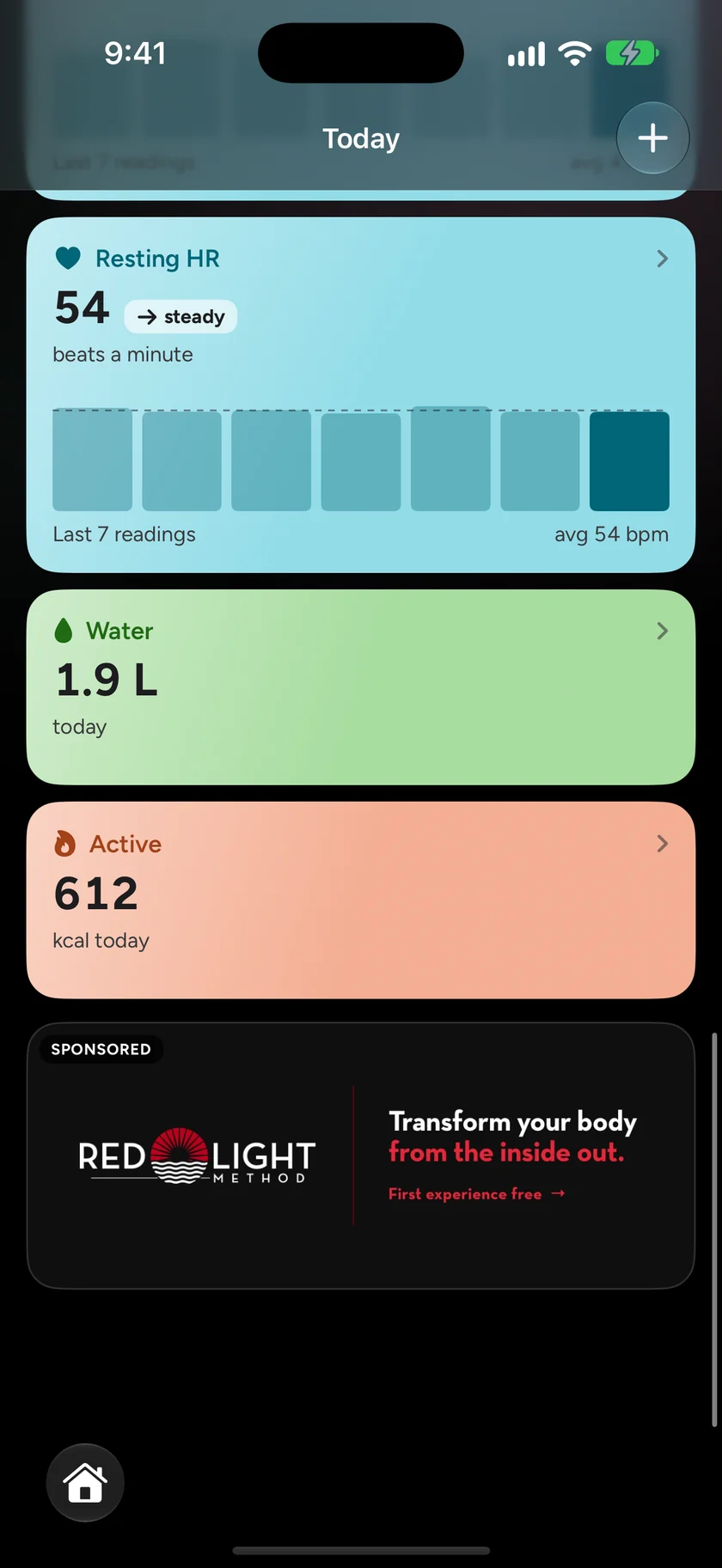
The rules, exactly:
- First-party creative only. Advertisers upload their ad; Wave shows it as supplied. No ad network’s code runs in the app.
- Always labeled. Every ad carries a visible “Sponsored” tag.
- Lifestyle screens only. Today, nutrition, fitness, sleep, goals, mind, the check-in, and the scan, but never while it is measuring.
- Never near the serious parts. No ads on your results, your trends, your messages, Ask or Wave Age.
- Counts, not people. Advertisers get the number of impressions and taps. Nothing about who saw them.
Underneath those rules is the part that makes them hold. There are no trackers in the app, no advertising identifier, no analytics kit and no third-party script. Your data is never sold, licensed or rented, and never shared with anyone for their own use; Wave AI, when you choose to use it, processes only what that feature needs and may use it for nothing else. A promise in a privacy policy is a sentence; the absence of third-party code is a fact about the software. There is simply nothing on board to report you to anyone.
You can also leave with everything. Ask through the contact form for a copy and you get your whole record within 30 days. Delete your account from inside the app and all of it goes, and disconnecting a device revokes its access at once.
Why free matters for a health tool
It would be simpler to charge a subscription. Wave does not, for a reason that is specific to health.
A wellness app earns its value slowly. The baseline takes weeks to form. The trend that tells you your resting heart rate has crept up, or that late meals are costing you sleep, shows up over months. A monthly fee asks you to decide whether it is worth it long before the useful part arrives, and many people reasonably decide it is not. A tool that only works if you keep using it should not make keeping it a recurring purchase.
What it does not fix
Honesty about the trade: you will see ads. They are labeled, they stay away from your results, and they know nothing about you, but they are there, and that is the price of free. And you are still trusting a company to keep its word. The difference is that the word is narrow, specific and written down, and the riskiest machinery is not merely switched off. It was never installed.
So, are you the product? In Wave, the product is a rectangle on a lifestyle screen with “Sponsored” on it. You are the person who gets to scroll past it.
Wave Wellness is free on the App Store and Google Play. Download it and see all of it working together today.