Type “why am I so tired” into a search bar or a general chatbot and you will get a good answer to a question you did not ask. You will get the common causes of tiredness in adults, ranked roughly by how often they turn up across millions of people. Sleep, stress, iron, thyroid, a long list that ends with something frightening.
What you will not get is the answer to your actual question, which was never about adults in general. It was about you, this month, and why this Tuesday felt like that.
The internet answers the average person
General knowledge is built from populations. That is its strength: it tells you what tends to be true across many people. It is also its limit, because you are one person, and the gap between “what is usually going on” and “what is going on with you” is where almost every useful health insight lives.
A general chatbot is a remarkable thing, and it is the same thing for everyone. It has read more about sleep than any sleep researcher alive and has never seen a single one of your nights. Asked about you, it can only do one of two things: answer about people like you, or guess. Neither is what you wanted.
Meanwhile, the answer you are after is often sitting in data you already have. When did the tiredness start? What else changed that week? Is it every morning, or the mornings after something? Those are questions about your own record, and a population cannot answer them, however large.
What Ask is
Ask, in Wave Wellness, takes plain-English questions, typed or spoken, and answers them from your own record only. Not the open internet, not what is generally true of people your age. Your sleep, your scans, your check-ins, your workouts, your meals, your labs, and how they line up.
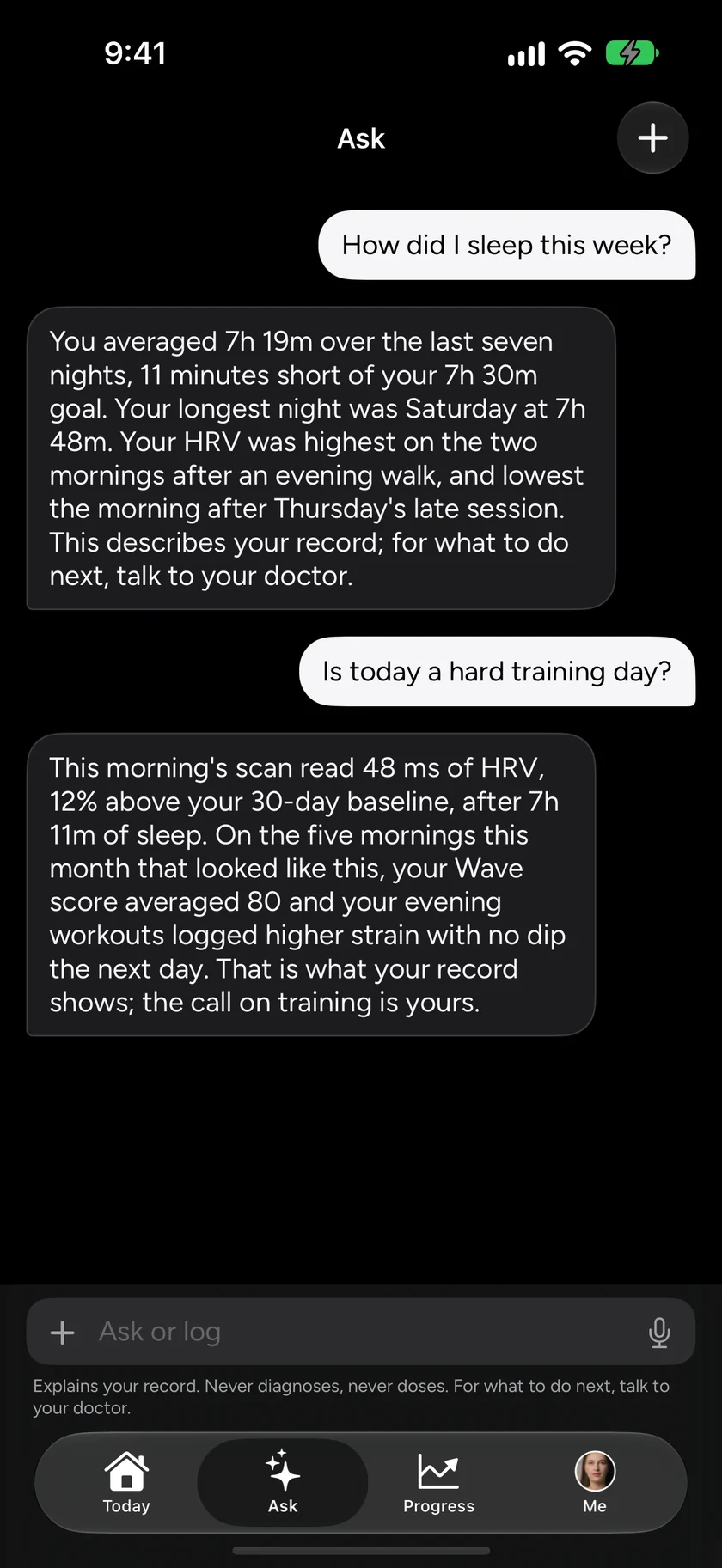
That screen is a sample, and it shows the shape of a good answer. Asked how the week’s sleep went, it gives the average, how far that sits from the goal, the longest night, and which mornings HRV ran highest and lowest. Asked whether today is a hard training day, it lays out this morning’s scan, what similar mornings looked like before, and then stops: the call on training is yours.
Questions worth asking
The best questions are the ones a search engine cannot touch, because the answer depends on your data. A few illustrative examples of the kind that work well:
- “What changed since last time?”
- “Do my mornings look different after a late workout?”
- “When did my resting heart rate start drifting up?”
- “How has my hs-CRP moved across my last few panels?”
Notice what they have in common. Each one is about a pattern in your own history, and each one would take you twenty minutes of scrolling through charts to answer yourself. That is the work Ask is for: reading across everything you have recorded and saying, in a sentence, what is there.
What it will not do
Ask has firm edges, and they are deliberate.
It never diagnoses. If your record shows something that looks off, it will describe what the record shows and suggest you talk to a doctor, and it will not name a condition. It never doses. “Should I take more vitamin D?” gets you your own vitamin D values over time and a pointer to the person who can answer the question properly. The line on the screen says it plainly: it explains your record, never diagnoses, never doses.
It also only knows what is in the record. If you did not log the late dinner, it cannot connect the late dinner to the bad night. It describes patterns, and a pattern is not a cause; two things that move together in your data are a lead worth following, not a verdict. A general chatbot will fill gaps like these with plausible-sounding general knowledge. Ask leaves the gap visible.
Where the answers come from, and where they go
Wave AI, which powers Ask, is Claude from Anthropic, and Anthropic does not train on what you send it. If you speak your question, the voice is turned into text on your device where it can be, and Wave receives the text, never the audio.
When you leave the Ask page, no transcript is kept. That is unusual for a chat interface, most of which store every conversation by default. But a running log of everything you ever wondered about your own health is exactly the kind of file nobody needs to exist. The record holds your data. Your questions about it can go when you are done asking.
The broader principle is worth keeping even outside the app. When a health question starts with “why do people”, the internet is a fine place to ask it. When it starts with “why do I”, the most useful source is the one that has actually been paying attention to you.
Wave Wellness is free on the App Store and Google Play. Download it and see all of it working together today.
Wave is for general wellness and is not a medical device. It does not diagnose or treat anything; talk to a doctor about symptoms, results or what to do next.